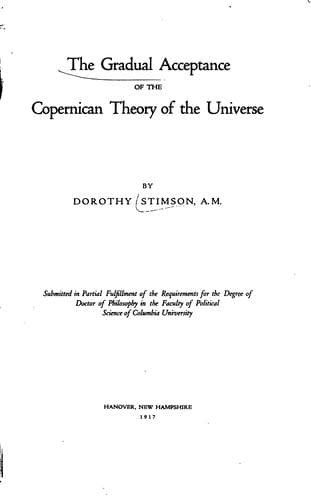
The gradual acceptance of the Copernican theory of the universeStimson, Dorothy
History
The gradual acceptance of the Copernican theory of the universe
Stimson, Dorothy
Astronomy -- History; Copernicus, Nicolaus, 1473-1543; Solar system
Four times was the old man summoned into the presence of the Holy
Office, though never when the Pope was presiding. In his first
examination held on the 12th of April, he told how he thought he had
obeyed the decree of 1616 as his _Dialogo_ did not defend the
Copernican doctrine but rather confuted it, and that in his desire to
do the right, he had personally submitted the book while in manuscript
to the censorship of the Master of the Sacred Palace, and had accepted
all the changes he and the Florentine Inquisitor had required. He had
not mentioned the affair of 1616 because he thought that order did not
apply to this book in which he proved the lack of validity and of
conclusiveness of the Copernican arguments.[271] With remarkable, in
fact unique, consideration, the Holy Office then assigned Galileo to a
suite of rooms within the prisons of the Holy Office, allowed him to
have his servant with him and to have his meals sent in by the
ambassador. On the 30th after his examination, they even assigned as
his prison, the Ambassador's palace, out of consideration for his age
and ill-health.
[Footnote 271: Ibid: 80-81.]
In his second appearance (April 30), Galileo declared he had been
thinking matters over after re-reading his book (which he had not read
for three years), and freely confessed that there were several
passages which would mislead a reader unaware of his real intentions,
into believing the worse arguments were the better, and he blamed
these slips upon his vain ambition and delight in his own skill in
debate.[272] He thereupon offered to write another "day" or two more
for the _Dialogo_ in which he would completely refute the two "strong"
Copernican arguments based on the sun's spots and on the tides.[273]
Ten days later, at his third appearance, he presented a written
statement of his defence in which he claimed that the phrase _vel
quovis modo docere_ was wholly new to him, and that he had obeyed the
order given him by Cardinal Bellarmin over the latter's own signature.
However he would make what amends he could and begged the Cardinals to
"consider his miserable bodily health and his incessant mental trouble
for the past ten months, the discomforts of a long hard journey at the
worst season, when 70 years old, together with the loss of the greater
part of the year, and that therefore such suffering might be adequate
punishment for his faults which they might condone to failing old age.
Also he commended to them his honor and reputation against the
calumnies of his ill-wishers who seek to detract from his good
name."[274] To such a plight was the great man brought! But the end
was not yet.
[Footnote 272: Doc. in Favaro: 83.]
[Footnote 273: Ibid: 84.]
[Footnote 274: Ibid: 85-87.]
Public-domain text, read in full here on John Shaqi.
Reviews
Reviews
No reviews yet
Be the first to share your thoughts on this work.
Join the Discussion
Join the discussion
Sign in to leave a comment or review.
Sign InorCreate an account