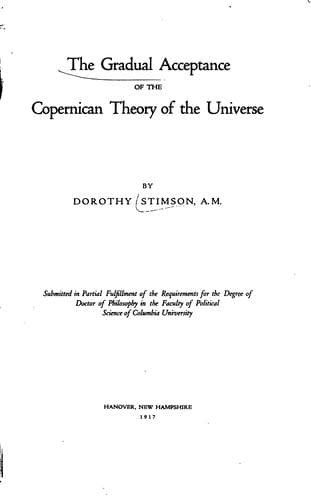
The gradual acceptance of the Copernican theory of the universeStimson, Dorothy
History
The gradual acceptance of the Copernican theory of the universe
Stimson, Dorothy
Astronomy -- History; Copernicus, Nicolaus, 1473-1543; Solar system
Nearly a month later (June 16), by order of the Pope, Galileo was once
again interrogated, this time under threat of torture.[275] Once again
he declared the opinion of Ptolemy true and indubitable and said he
did not hold and had not held this doctrine of Copernicus after he had
been informed of the order to abandon it. "As for the rest," he added,
"I am in your hands, do with me as you please." "I am here to
obey."[276] Then by the order of the Pope, ensued Galileo's complete
abjuration on his knees in the presence of the full Congregation,
coupled with his promise to denounce other heretics (i.e.,
Copernicans).[277] In addition, because he was guilty of the heresy of
having held and believed a doctrine declared and defined as contrary
to the Scriptures, he was sentenced to "formal imprisonment" at the
will of the Congregation, and to repeat the seven penitential Psalms
every week for three years.[278]
[Footnote 275: Ibid: 101.]
[Footnote 276: Doc. in Favaro: 101.]
[Footnote 277: Doc. in Favaro: 146.]
[Footnote 278: Ibid: 145.]
At Galileo's earnest request, his sentence was commuted almost at
once, to imprisonment first in the archiepiscopal palace in Siena
(from June 30-December 1), then in his own villa at Arcetri, outside
Florence, though under strict orders not to receive visitors but to
live in solitude.[279] In the spring his increasing illness occasioned
another request for greater liberty in order to have the necessary
visits from the doctor; but on March 23, 1634, this was denied him
with a stern command from the Pope to refrain from further petitions
lest the Sacred Congregation be compelled to recall him to their
prisons in Rome.[280]
[Footnote 279: Ibid: 103, 129.]
[Footnote 280: Ibid: 134.]
The rule forbidding visitors seems not to have been rigidly enforced
all the time, for Milton visited him, "a prisoner of the Inquisition"
in 1638;[281] yet Father Castelli had to write to Rome for permission
to visit him to learn his newly invented method of finding longitude
at sea.[282] When in Florence on a very brief stay to see his doctor,
Galileo had to have the especial consent of the Inquisitor in order to
attend mass at Easter. He won approval from the Holy Congregation,
however, by refusing to receive some gifts and letters brought him by
some German merchants from the Low Countries.[283] He was then totally
blind, but he dragged out his existence until January 8, 1642 (the
year of Newton's birth), when he died. As the Pope objected to a
public funeral for a man sentenced by the Holy Office, he was buried
without even an epitaph.[284] The first inscription was made 31 years
later, and in 1737, his remains were removed to Santa Croce after the
Congregation had first been asked if such action would be
unobjectionable.[285]
[Footnote 281: Milton: _Areopagitica_: 35.]
[Footnote 282: Doc. in Favaro: 135.]
[Footnote 283: Ibid: 137.]
[Footnote 284: Fahie: 402.]
[Footnote 285: Doc. in Favaro: 138; and Fahie: 402.]
Public-domain text, read in full here on John Shaqi.
Reviews
Reviews
No reviews yet
Be the first to share your thoughts on this work.
Join the Discussion
Join the discussion
Sign in to leave a comment or review.
Sign InorCreate an account