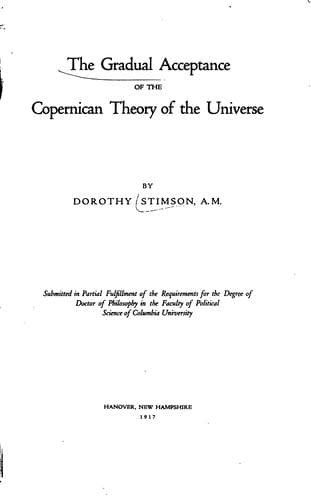
The gradual acceptance of the Copernican theory of the universeStimson, Dorothy
History
The gradual acceptance of the Copernican theory of the universe
Stimson, Dorothy
Astronomy -- History; Copernicus, Nicolaus, 1473-1543; Solar system
In spite of Froidmont's position, the University of Louvain was not
cordial in its response to the papal nuncio's announcement in
September, 1633, of Galileo's abjuration and sentence, in marked
contrast to the reply sent by the neighboring university of Douay. The
latter body, in a letter signed by Matthæus Kellison (Sept. 7, 1633),
declared the condemned theory "should be discarded and hissed from the
schools; and that in the English College there in Douay, this paradox
never had been approved and never would be, but had always been
opposed and always would be."[315]
[Footnote 315: Doc. in Favaro: 120-121, 132, 133.]
This opposition in the universities in Belgium continued throughout
the century to be based not so much on scientific grounds as upon the
Bible. This may be seen in the manuscript reports of lectures in
physics and astronomy given at Liège in 1662, and at Louvain between
1650-1660, though one of these does not mention the decree of
1616.[316] The general congregation of the Society of Jesus in 1650
drew up a list of the propositions proscribed in their teaching,
though, according to M. Monchamp (himself a Catholic) not thereby
implying a denial of any probability they might have. The 35th
proposition ran: "Terra movetur motu diurno; planetæ, tanquam
viventia, moventur ab intrinseco. Firmamentum stat."[317] The Jesuit
astronomer Tacquet in his textbook (Antwerp, 1669) respected this
decision, acknowledging that no scientific reason kept him from
defending the theory, but solely his respect for the Christian
faith.[318]
[Footnote 316: Monchamp: 125, 143.]
[Footnote 317: Ibid: 148-149.]
[Footnote 318: Ibid: 152-153.]
One of the pupils of the Jesuits revolted however. Martin van Welden,
appointed professor of mathematics at Louvain in 1683, debated a
series of theses in January, 1691. The second read: "Indubitum est
systhema Copernici de planetarum motu circa sole; inter quos merito
terra censetur." His refusal to alter the wording except to change
_indubitum_ to _certum_ brought on a stormy controversy within the
faculty which eventually reached the Council of Brabant and the papal
nuncio at Brussels.[319] The professor finally submitted, though he
was not forbidden to teach the Copernician system, nor did the faculty
affirm its falsity, merely that it was contrary to the Roman decree.
The professor re-opened the matter with a similar thesis in July,
thereby arousing a second controversy that this time reached even the
Privy Council. Once more he submitted, but solely with an apology for
having caused a disagreement. His new theses in 1695 contained no
explicit mention of the Copernician system; at least he had learned
tact.[320]
[Footnote 319: Ibid: 182-234.]
[Footnote 320: Monchamp: 321.]
Public-domain text, read in full here on John Shaqi.
Reviews
Reviews
No reviews yet
Be the first to share your thoughts on this work.
Elsewhere in the archive
Join the Discussion
Join the discussion
Sign in to leave a comment or review.
Sign InorCreate an account