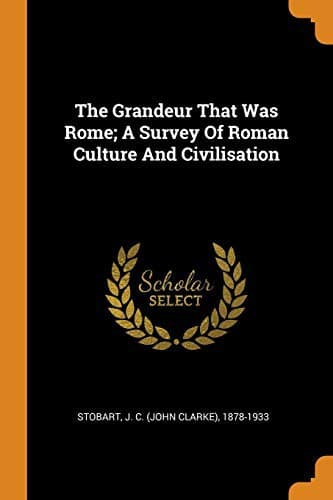
The Grandeur That Was Rome: a survey of Roman culture and civilisationStobart, J. C. (John Clarke)
History
The Grandeur That Was Rome: a survey of Roman culture and civilisation
Stobart, J. C. (John Clarke)
Rome -- Civilization; Rome -- History
The destruction of these two cities, Corinth and Carthage, together
with other facts such as the unreasonable irritation which Rome
displayed against her Greek allies, Rhodes and Pergamum, have been
taken by some modern historians to indicate, once more, a policy of
commercial jealousy instigating the destruction of rival markets. In
the one case, however, it has been proved that Corinth was no longer a
great centre of Greek commerce when she was destroyed, and in the case
of Carthage it was the party of Cato, who was much more of a farmer
than a company-promoter, that urged destruction. A man of business
might indeed be foolish enough to want to close the principal markets
which bought and sold with him--there are such business men to-day--but
he would scarcely be so mad as to have a fine commercial centre with
its docks and quays utterly destroyed and cursed for ever. Similarly,
when Macedon was conquered her rich gold mines were shut down by
order of the senate. The truth is that Rome was tired and exhausted
with her colossal wars, irritable and nervous beyond expression with
the gigantic task of government which she had found thrust upon her.
Surrounded with false friends and secret enemies, she was losing the
noble _sang froid_ she had displayed in times of real crisis. Corinth
was destroyed as a warning to the Greeks, Carthage as an expiation for
the _lemures_ of the unburied Roman dead.
THE PROVINCES
In considering the ancient, imperial, and provincial systems it is
necessary for the modern to divest himself of all the geographical
notions which spring from the study of maps. The ancients probably
had only the most vague notions of territory. Natural frontiers such
as mountains, rivers, and coasts were of course familiar to them, from
the strategic point of view. Within those were cities great and small,
which in the case of civilised people formed the units of life and
government. In the case of barbarians there were tribes and nations,
seldom sufficiently settled to produce any notion of geographical
area. Thus when Rome conquered Sicily she was acquiring not so much
one geographical unit, an island, as a collection of states of various
types and constitutions. Similarly in the case of Spain; she said
and thought that she acquired Spain, although the greater part of
the Iberian peninsula remained unconquered for another century and a
half. To remember the limitations of ancient geographical knowledge
is essential to the understanding of the Roman provincial system.
_Provincia_ means in the first instance a sphere of official duty, a
man’s _provincia_ might be the feeding of the sacred geese or it might
be the control of an army. It was not for a long time that the word
came to connote a territorial area. When it did so, the day of the
city-state was at an end.
Public-domain text, read in full here on John Shaqi.
Reviews
Reviews
No reviews yet
Be the first to share your thoughts on this work.
Join the Discussion
Join the discussion
Sign in to leave a comment or review.
Sign InorCreate an account