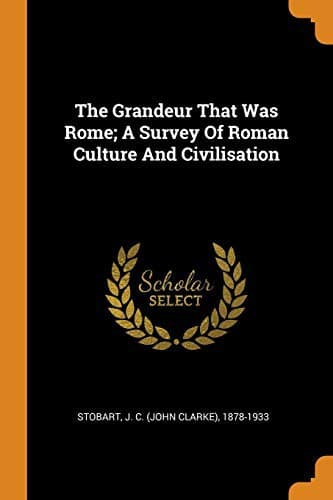
The Grandeur That Was Rome: a survey of Roman culture and civilisationStobart, J. C. (John Clarke)
History
The Grandeur That Was Rome: a survey of Roman culture and civilisation
Stobart, J. C. (John Clarke)
Rome -- Civilization; Rome -- History
The corruption, as we shall see later, began to be serious with the
acquisition of Asia. At first the incompetence due to the inexperience
of the governors and their staffs was the chief failing of the system.
But when Asia with its stored-up capital, its possibilities of
exploitation, and its extreme helplessness, fell to Rome, traders and
money-lenders swarmed down upon it, so that there were 80,000 Italians
there when Mithradates ordered his famous massacre. Thus money poured
into the capital, and there was an unseemly scramble for wealth. But
for the present we are only concerned with the system of provincial
government as it was in the beginning. I think we may conclude that it
started with the best intentions, but with two inherent defects, both
due to the conservatism of the Roman character. Their constitution
was municipal and their outlook parochial. Their empire-building was
precisely of the narrow-minded, well-intentioned character that one
would expect if the Marleybone Borough Council suddenly found itself
presented with Ireland, France, and half Spain, and asked to govern
them.
THE IMPERIAL CITY
A poor man cannot become a millionaire without at least altering his
way of living, and a little backward provincial town cannot find
itself the mistress of a great empire without undergoing very profound
modifications. In 208 B.C. Rome was struggling for her life with a
foreign enemy raging at her gates. Fifty years later she was mistress
in the Mediterranean, and owner of more land than she could conceive.
Public-domain text, read in full here on John Shaqi.
Reviews
Reviews
No reviews yet
Be the first to share your thoughts on this work.
Join the Discussion
Join the discussion
Sign in to leave a comment or review.
Sign InorCreate an account