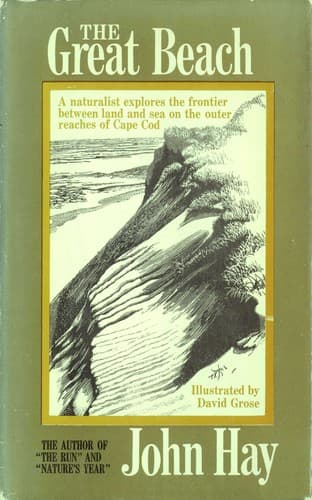
Cape Cod (Mass.) -- Description and travel; Natural history -- Massachusetts -- Cape Cod
I wonder, in that light which changes for us every hour, every minute
of the day, through the wild wastes of the sky, through the countless
years of earthly inheritance and change, how we became so overmastering
in our numbers and needs, so divorced from the exactions of nature?
Shall we meet up only with ourselves?
Perhaps all hunters, those who know their deer, their mountains, and
their forests, with an ancient admiration, and even those who abuse a
hunter’s “right,” knowing nothing but confusion, are trying to keep in
contact with a natural mortality which our world denies. Perhaps we
need help from other animals besides the human one.
Everything in this landscape, from gulls and ducks to driftwood,
marsh grasses, and deer, had a vital distinction. The beach with its
perpetual reshaping and scouring worked on each stone and lifted
each grain of sand, so long as there was stone and sand. The gulls
hung overhead, colors fitting the shore and sky. Even the boat had
a fittingness, a sea size of its own, and so with feathers, logs, or
purple stones, all in solitary nobility, but swept and washed into a
mutual keeping by the air and the tidal presence of the sea. I asked
it to show us light and life which was our undiscovered own to help us
through our mutual violence and upheavals, our narrow days.
XI
Impermanence Takes Its Stand
Just as the sand bars offshore change shape continually, and the beach
loses and gains in volume and elevation, so the plants and trees work
so hard to hold on in their shifting ground that they never reach a
climax state. They are pioneers. Such a place is open, as all earth’s
shores must be, to drifters, like the black stork.
The driftwood that lands on the beach and sometimes piles up in great
numbers and bulk on the upper tide level after a storm, could come in
from almost anywhere: Africa, Brazil, Massachusetts, Maine, or Nova
Scotia, depending on how it was transported, by ships or by the sea
itself. Years ago, sailing ships traveling along the Outer Cape with
cargoes of lumber chained to their decks might encounter heavy seas and
be in serious danger of grounding on the shoals, in which case they
would occasionally jettison the cargo, which would land up and down
the beaches, to be picked up by those famous human scavengers, the
“moon-cussers.” Since such lumber was often in the form of planks or
studding, it supplied many a family with material for their houses. I
can think of at least one house which is largely constructed of it.
Public-domain text, read in full here on John Shaqi.
Reviews
Reviews
No reviews yet
Be the first to share your thoughts on this work.
Join the Discussion
Join the discussion
Sign in to leave a comment or review.
Sign InorCreate an account