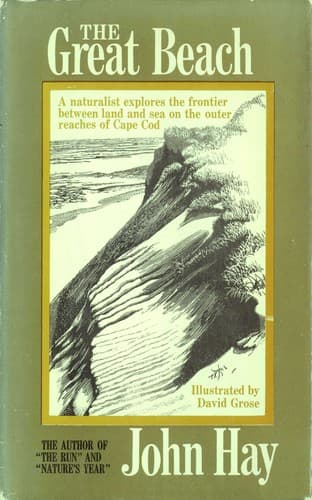
Cape Cod (Mass.) -- Description and travel; Natural history -- Massachusetts -- Cape Cod
Or as it happened not so many years ago, a log jam in a Maine river
broke the boom and the logs went careening and dipping down to the sea,
a great many landing after a while on the Outer Beach. Huge trunks of
trees sometimes appear, carried in by the sea. I have found cherry,
red and white pine, cedar, spruce, beech, and even some canoe birch
with the bark still on it, a tree not indigenous to the Cape. Mahogany
and walnut have been found at times, and a few years ago the cross
section of a tree was discovered near Eastham that turned out to be a
very hard and heavy wood from Brazil, probably fallen off a ship. Parts
of dories, or larger vessels, broken oars; buoys of all colors and
shapes, glass floats from lobster pots, branches, logs; boards of many
different sizes and lengths, wharf pilings and planks, and dunnage,
timbers used in stowing ship’s cargoes, cases of scotch, always, in
my sad experience, without the scotch; crates from vessels of all the
world, South American, Russian, Japanese, French, and most of the
nations you can name; all these and more have been carried by the sea,
sometimes for twenty or thirty years, until they were finally landed on
the beach. It is wood for the fire, a house, a shack, or a table, and
material for any curious scavenger, on behalf of aesthetics, science,
or history.
The driftwood is a migrant, to move again soon, unless it is taken
off the beach, burned in a fire, or lodged and buried deep above the
high-tide line. It may serve temporarily as a place where seaweed and
other litter gathers, or where crustaceans might congregate. The birds,
if it is an accessible clump of branches fingering over the sands,
rather than a log or heavy timber, may peck through it after such tiny
animals, their tracks making a delicate tracery running under it and
arrowing away. Driftwood migrates like the sand and the birds. It is
another aspect of the surf’s swing and draw, its dragging out, its
removal and its deposition, part of the constant remolding of this
shore.
On the cliff tops too, over the beach and the round horizon, everything
goes out and round and returns. A curve is the only rule. As it does
everywhere on the Cape, the wind goes across from one direction of
the compass or another, streaming with light and moisture, lifts up,
lifts you to it, and with long low swoops, sudden breaths and seething,
it whisks the waters of the marshes and inlets, rounds their brown
shoulders, races through trees and over cliffs clean through across the
sea. The land under it, held down more definitely than beach or dunes,
also waves as they do.
Public-domain text, read in full here on John Shaqi.
Reviews
Reviews
No reviews yet
Be the first to share your thoughts on this work.
Join the Discussion
Join the discussion
Sign in to leave a comment or review.
Sign InorCreate an account