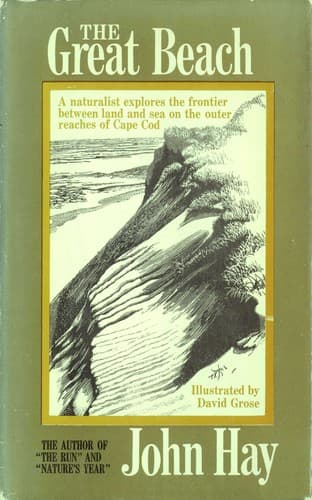
Cape Cod (Mass.) -- Description and travel; Natural history -- Massachusetts -- Cape Cod
One day I had walked for several miles along the cliffs toward Eastham,
through thickets of scrub oak, and bayberry that smelled very pungently
in the fall of the year. The sky was full of shifting winds and the day
as I walked full of weather changes, from an edge of cold to warmth
and back again. An early sun began to be covered by pale-gray clouds
and there was a mauve light over the sea. I caught sight of a little
wren along the way, and there was a number of sparrows, both seen and
heard--song, chipping, seaside, and probably others. It was a low,
shifting thicket world full of potential surprise, bordered by oceanic
sound, rocking with light and air.
I retraced my steps a few hours later over a narrow sandy road, at
times no more than a track, and I saw a pigeon hawk flying off ahead
of me, stroking deliberately and quickly with its long wings. Then I
noticed another one roosting on a broken-off tree several hundred feet
back of the cliff just outside a wood of pitch pines. The first one
made off in that direction too, roosting not far from its companion on
a dead stump, and they both stayed absolutely still, like falcons on
an Egyptian frieze. I could hear a blue jay screaming somewhere in the
background.
I noticed feathers scattered on the path, gray and blue, blowing ahead
of me; and then, there it was, a blue jay freshly killed, its breast
bare of feathers and shining red like some rock wet with sea splash
in the crimson path of the setting sun. What kind of a game led up to
this? Could the two hawks, one tempting the jay by its distance, the
other scaring it by its proximity, have managed to send it out into the
open where it had no chance against their swift and effortless pursuit?
I walked ahead for a short distance and then waited, watching through
field glasses for the hawks to come back. The nearest one did, after a
few minutes, beating down tentatively over the kill, then rising again
and leaving with its supple flight. The other had moved a little closer
and roosted on an abandoned telephone pole, full of an ancient poise,
wonderfully still. After that, I am sure, they never went back to the
road until I had gone for good. The grace and tension, the space in
that formal scene stayed with me for a long time.
XIV
The Marsh
Public-domain text, read in full here on John Shaqi.
Reviews
Reviews
No reviews yet
Be the first to share your thoughts on this work.
Elsewhere in the archive
Join the Discussion
Join the discussion
Sign in to leave a comment or review.
Sign InorCreate an account