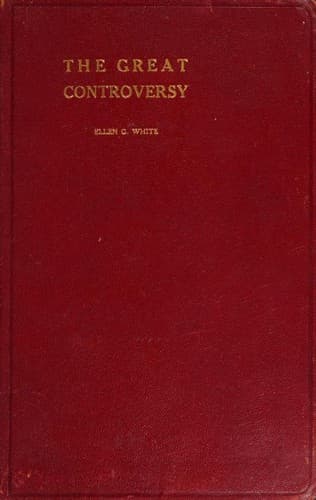
The Great Controversy Between Christ and SatanWhite, Ellen Gould Harmon
ReligionComparative
The Great Controversy Between Christ and Satan
White, Ellen Gould Harmon
Good and evil; Seventh-Day Adventists -- Doctrines; Spiritual direction
Wycliffe’s words were fulfilled. He lived to place in the hands of his
countrymen the most powerful of all weapons against Rome,—to give them the
Bible, the Heaven-appointed agent to liberate, enlighten, and evangelize
the people. There were many and great obstacles to surmount in the
accomplishment of this work. Wycliffe was weighed down with infirmities;
he knew that only a few years for labor remained for him; he saw the
opposition which he must meet; but, encouraged by the promises of God’s
word, he went forward nothing daunted. In the full vigor of his
intellectual powers, rich in experience, he had been preserved and
prepared by God’s special providence for this, the greatest of his labors.
While all Christendom was filled with tumult, the Reformer in his rectory
at Lutterworth, unheeding the storm that raged without, applied himself to
his chosen task.
At last the work was completed,—the first English translation of the Bible
ever made. The word of God was opened to England. The Reformer feared not
now the prison or the stake. He had placed in the hands of the English
people a light which should never be extinguished. In giving the Bible to
his countrymen, he had done more to break the fetters of ignorance and
vice, more to liberate and elevate his country, than was ever achieved by
the most brilliant victories on fields of battle.
The art of printing being still unknown, it was only by slow and wearisome
labor that copies of the Bible could be multiplied. So great was the
interest to obtain the book, that many willingly engaged in the work of
transcribing it, but it was with difficulty that the copyists could supply
the demand. Some of the more wealthy purchasers desired the whole Bible.
Others bought only a portion. In many cases, several families united to
purchase a copy. Thus Wycliffe’s Bible soon found its way to the homes of
the people.
The appeal to men’s reason aroused them from their passive submission to
papal dogmas. Wycliffe now taught the distinctive doctrines of
Protestantism,—salvation through faith in Christ, and the sole
infallibility of the Scriptures. The preachers whom he had sent out
circulated the Bible, together with the Reformer’s writings, and with such
success that the new faith was accepted by nearly one half of the people
of England.
The appearance of the Scriptures brought dismay to the authorities of the
church. They had now to meet an agency more powerful than Wycliffe,—an
agency against which their weapons would avail little. There was at this
time no law in England prohibiting the Bible, for it had never before been
published in the language of the people. Such laws were afterward enacted
and rigorously enforced. Meanwhile, notwithstanding the efforts of the
priests, there was for a season opportunity for the circulation of the
word of God.
Public-domain text, read in full here on John Shaqi.
Reviews
Reviews
No reviews yet
Be the first to share your thoughts on this work.
Join the Discussion
Join the discussion
Sign in to leave a comment or review.
Sign InorCreate an account