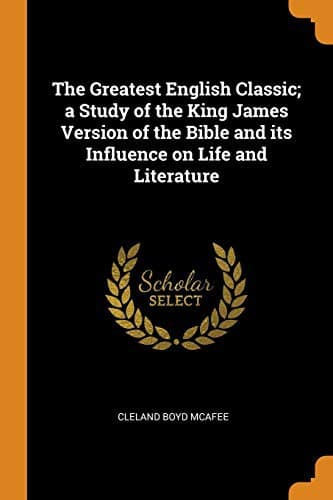
The Greatest English Classic: A Study of the King James Version of the Bible and Its Influence on Life and LiteratureMcAfee, Cleland Boyd
History
The Greatest English Classic: A Study of the King James Version of the Bible and Its Influence on Life and Literature
McAfee, Cleland Boyd
Bible -- History; Bible -- Influence; Bible and literature; Bible. English -- Versions -- Authorized
From this point of view the times were not
perfectly opportune for a piece of pure English
literature, though it was the time which
produced Shakespeare. A definite movement was
on to refine the language by foreign decorations.
Not even Shakespeare avoids it always. No
writer of the time avoids it wholly. The
dedication of the King James version shows that
these scholars themselves did not avoid it. In
that dedication, and their preface, they give us
fine writing, striving for effect, ornamental
phrases characteristic of the time. Men were
feeling that this English language was rough and
barbarous, insufficient, needing enlargement by
the addition of other words constructed in a
foreign form. The essays of Lord Bacon are
virtually contemporaneous with this translation.
Macaulay says a rather hard word in calling
his style "odious and deformed,"[1] but when
one turns from Bacon to the English Bible there
is a sharp contrast in mere style, and it favors
the Bible. The contrast is as great as that which
Carlyle first felt between the ideas of Shakespeare
and those of the Bible when he said that
"this world is a catholic kind of place; the
Puritan gospel and Shakespeare's plays: such
a pair of facts I have rarely seen save out of one
chimerical generation."[2] And that gives point
to the word already quoted from Hallam that
the English of the King James version is not
the English of James I.
[1] Essay on John Dryden.
[2] Historical Sketches, Hampton Court Conference.
Four things helped to determine the simplicity
and pure English--unornamented English--of
the King James version, made it, that
is, the English classic. Two of these things have
been dealt with already in other connections.
First, that it was a Book for the people, for the
people of the middle level of language; a work
by scholars, but not chiefly for scholars, intended
rather for the common use of common people.
Secondly, that the translators were constantly
beholden to the work of the past in this same
line. Where Wiclif's words were still in use
they used them. That tended to fix the language
by the use which had already become
natural.
Public-domain text, read in full here on John Shaqi.
Reviews
Reviews
No reviews yet
Be the first to share your thoughts on this work.
Elsewhere in the archive
Join the Discussion
Join the discussion
Sign in to leave a comment or review.
Sign InorCreate an account