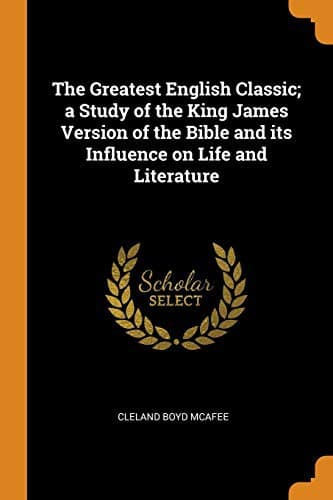
The Greatest English Classic: A Study of the King James Version of the Bible and Its Influence on Life and LiteratureMcAfee, Cleland Boyd
History
The Greatest English Classic: A Study of the King James Version of the Bible and Its Influence on Life and Literature
McAfee, Cleland Boyd
Bible -- History; Bible -- Influence; Bible and literature; Bible. English -- Versions -- Authorized
Then, Secondly, the words are short, and in
general short words are the strong ones. The
average word in the whole Bible, including the
long proper names, is barely over four letters,
and if all the proper names are excluded the average
word is just a little under four letters. Of
course, another way of saying that is that the
words are generally Anglo-Saxon, and, while in
the original spelling they were much longer, yet
in their sound they were as brief as they are in
our present spelling. There is no merit in Anglo-
Saxon words except in the fact that they are
concrete, definite, non-abstract words. They
are words that mean the same to everybody;
they are part of common experience. We shall
see the power of such words by comparing a
simple statement in Saxon words from the
English Bible with a comment of a learned
theologian of our own time on them. The
phrase is a simple one in the Communion service:
"This is my body which is given for you."
That is all Saxon. When our theologian comes
to comment on it he says we are to understand
that "the validity of the service does not lie
in the quality of external signs and sacramental
representation, but in its essential property and
substantial reality." Now there are nine words
abstract in their meaning, Latin in their form.
It is in that kind of words that the Bible could
have been translated, and in our own day might
even be translated. Addison speaks of that:
"If any one would judge of the beauties of poetry
that are to be met with in the divine writings,
and examine how kindly the Hebrew manners of
speech mix and incorporate with the English
language, after having perused the Book of
Psalms, let him read a literal translation of
Horace or Pindar. He will find in these two
last such an absurdity and confusion of style
with such a comparative poverty of imagination,
as will make him very sensible of what I have
been here advancing."[1]
[1] The Spectator, No. 405.
Public-domain text, read in full here on John Shaqi.
Reviews
Reviews
No reviews yet
Be the first to share your thoughts on this work.
Elsewhere in the archive
Join the Discussion
Join the discussion
Sign in to leave a comment or review.
Sign InorCreate an account