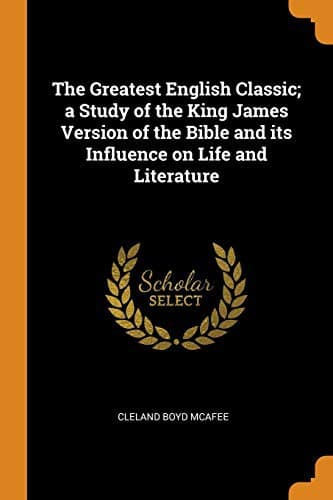
The Greatest English Classic: A Study of the King James Version of the Bible and Its Influence on Life and LiteratureMcAfee, Cleland Boyd
History
The Greatest English Classic: A Study of the King James Version of the Bible and Its Influence on Life and Literature
McAfee, Cleland Boyd
Bible -- History; Bible -- Influence; Bible and literature; Bible. English -- Versions -- Authorized
Rising now from this basal element in the
literature of the version, we come to the place
where its style and its ideas blend in what we
may call its earnestness. That is itself a literary
characteristic. There is not a line of trifling
in the book. No man would ever learn
trifling from it. It takes itself with tremendous
seriousness. Here are earnest men at work;
to them life is joyous, but it is no joke. That is
why the element of humor in it is such a small
one. It is there, to be sure. Many of its
similes are intended to be humorous. A few of
its incidents are humorous; but it has little
of that element in it, as indeed little of our literature has
that element markedly in it. We have
a few exceptions. But what George Eliot says
in Adam Bede is true, that wit is of a temporary
nature, and does not deal with the deep and
more lasting elements in life. The Bible is not
a sad book. There are children at play in it;
there are feasts and buoyant gatherings fully
recounted. But it never trifles nor jests.
So it has given us a language of great dignity.
Let Addison speak again: "How cold and dead
does a prayer appear that is composed in the
most elegant and polite forms of speech, which
are natural to our tongue, when it is not heightened
by that solemnity of phrase which may be
drawn from the sacred writings. It has been
said by some of the ancients that if the gods
were to talk with men, they would certainly
speak in Plato's style; but I think we may say,
with justice, that when mortals converse with
their Creator they cannot do it in so proper a
style as in that of the Holy Scriptures."
As that earnestness of the literature of the
original precluded any great amount of humor
in the wide range of its literary forms, so in the
King James version it precluded any trifling expressions, any
plays on words, even the duplication
of such plays as can be found in the Hebrew
or the Greek. You seldom find any turn of a
word in the King James version, though you do
occasionally find it in the Hebrew. One such
punning expression occurs in the story of Samson
(Judges xv:16), where our version reads:
"With the jawbone of an ass, heaps upon heaps,
with the jawbone of an ass have I slain a thousand
men." In the Hebrew the words translated
"ass" and "heaps" are variants of the
same word. It comes near the Hebrew to say:
"With the jawbone of an ass, masses upon
masses," and so on. These translators would
not risk reproducing such puns for fear of lowering
the dignity of their results. There is a
deadly seriousness about their work and so
they never lose strength as they go on.
Public-domain text, read in full here on John Shaqi.
Reviews
Reviews
No reviews yet
Be the first to share your thoughts on this work.
Elsewhere in the archive
Join the Discussion
Join the discussion
Sign in to leave a comment or review.
Sign InorCreate an account