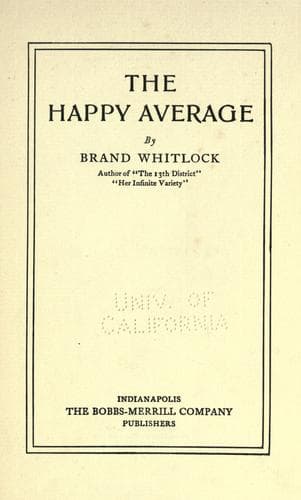
Betrothal -- Fiction; Courtship -- Fiction; Middle West -- Fiction; United States -- Social life and customs -- Fiction
It was one of the incomparable afternoons that autumn brings to Ohio;
the retreating sun was flashing in the high, blue sky; the air was fresh
and Marley felt it full of energy and hope. Lawrence drove rapidly
through the throng of hurrying vehicles that crowded the road to the
fair-grounds, stirring up a cloud of dust that covered everything with
its white powder.
Lawrence left him at the gate, being too full of business to engage in
the weary search for pleasure, and Marley set out alone across the
scorched and trampled turf for the grand stand, black with people for
the races. He could hear the nervous clamor of the bell in the judges'
stand, the notes of the hand-organ at the squeaking merry-go-round, the
incessant thumping of the bass drum that made its barbaric music for the
side-show, and the cries of venders, dominating all the voices of the
thousands bent in their silly way on pleasure. Once, calling him back to
the real, to the peace of the commonplace, he heard the distant tones of
the town clock in the tower that stood, a mile away, above the autumnal
trees.
He pressed into the space between the grand stand and the whitewashed
fence that surrounded the track; through the palings he could see the
stoop-shouldered drivers, bent over the heavily breathing trotters they
jogged to and fro; above him, in the grand stand, he could distinguish
cries and laughs, now and then complete excited sentences, sometimes
voices he knew. All around him the farmers, clumsy in their ready-made
clothes and bearing their buggy whips as some insignia of office,
solemnly watched the races and talked of horses.
The sense of kinship with the crowd that had unerringly drawn Marley
left him the moment he was in the crowd, and a loneliness replaced the
sense of kinship. He looked about for some one he knew. He began, here
and there, to recognize faces, just as he had recognized voices in the
din above him; he began to analyze and to classify the crowd, and he
laughed somewhat cynically when he saw numbers of politicians going
about among the farmers, shaking their hands, greeting them effusively,
calling them by their Christian names. Then suddenly he saw Wade Powell.
The crowd at the point where Powell stood, nucleated with him as its
center; by the way the men were laughing, and by the way Powell was
trying not to laugh, Marley knew that he had been telling them one of
his stories, and from the self-conscious, guilty expressions on certain
of the faces, Marley knew that the story was probably one that should
not have been told. Several countrymen hung on the edge of the group,
not identifying themselves with it, yet anxious to have a look at Wade
Powell, who enjoyed the fame of the county's best criminal lawyer.
Public-domain text, read in full here on John Shaqi.
Reviews
Reviews
No reviews yet
Be the first to share your thoughts on this work.
Elsewhere in the archive
Join the Discussion
Join the discussion
Sign in to leave a comment or review.
Sign InorCreate an account