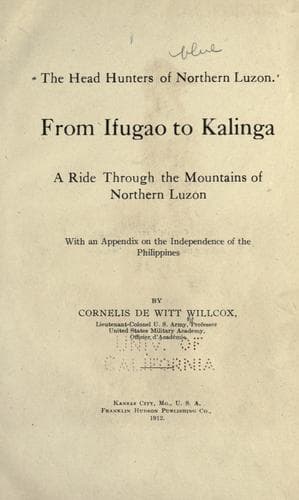
The Head Hunters of Northern LuzonWillcox, Cornélis De Witt
History
The Head Hunters of Northern Luzon
Willcox, Cornélis De Witt
Igorot (Philippine people); Luzon (Philippines) -- Description and travel
From Banawe we rode to Bontok, thirty-five miles, in one day, May
7th. This day it rained, the only rain we had during the whole trip,
although the season was now on. But the disturbance in question was
due to a typhoon far to the southward; and as it passed off into the
China Sea, so did the day finally clear. Our first business this
morning was to cross the pass on Polis Mountain, some 6,400 feet
above sea-level, the highest elevation we reached. As we rode out of
Banawe we could see on the wooded sky-line to our right front a cut
as though of a road through the forest; it was not a road, of course,
but an opening normal to the crest of the ridge. Across this a net is
stretched, and the bats, flying in swarms by night to clear the top,
drop into the cut on reaching it, and so are caught in the net in
flying across. We saw several such bat-traps during our trip. In this
way these highlanders eke out their meager supply of meat. The bat in
question is not the animal we are familiar with, but the immensely
larger fruit bat, the flesh of which is readily eaten. Our trail
took us up, and sharply; by nine o'clock we had crowned the pass,
and stopped for chow and rest. In front of us, as we looked back,
plunged the deepest, sharpest valley yet seen, around the head
of which we had ridden and across which we could look down on the
Ifugao country we had just come from; down one side and up the other
could be traced the remains of the old Spanish trail, a miracle of
stupidity. To the right (west), but out of sight, lay Sapao, where the
rice-terraces have received their greatest development, rising from the
valley we were gazing into some 3,000 feet up the slope. Sapao, too,
is the seat of the Ifugao steel industry, so that for many reasons I
was sorry it was off our itinerary. The point where we were resting
has some interest from its associations, for our troops reached it
in their pursuit of Aguinaldo, at the end of a long day of rain,
and had to spend the night without food or fire or sleep. It was not
possible to light a pipe even, a _noche triste_ indeed. Most of the
men stood up all night, this being better than lying down in the mud;
to march on was impossible, as the country was then trailless, except
for the Spanish trail mentioned, to attempt which by night would have
been suicide. A tropical forest can be pretty dreary in bad weather,
almost as dreary as a Florida cypress swamp on a rainy Sunday.
Public-domain text, read in full here on John Shaqi.
Reviews
Reviews
No reviews yet
Be the first to share your thoughts on this work.
Elsewhere in the archive
Join the Discussion
Join the discussion
Sign in to leave a comment or review.
Sign InorCreate an account