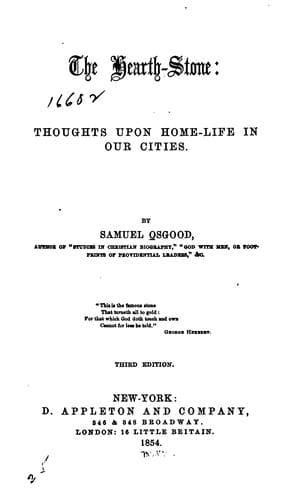
The Hearth-Stone: Thoughts Upon Home-Life in Our CitiesOsgood, Samuel
Religion
The Hearth-Stone: Thoughts Upon Home-Life in Our Cities
Osgood, Samuel
Christian life; Conduct of life
Manners are but lesser morals, and closely connected with the greater
morals. Good manners begin at home, and if they do not begin there, the
desire for them is apt to end in poor affectation. The soul of politeness
is mutual deference, and where should this have its origin but in the
respect most directly sanctioned by God? Too often the true filial honor
is forgotten, and, perhaps, from thoughtlessness more than disrespect,
children are sometimes seen usurping the prerogatives of age, speaking in
tones of petulant authority, and crowding themselves into the places of
elders. The best place for them is their own place. Their own dignity, as
well as that of their parents, is best furthered by the deference, that
gives the household its best order and makes it the school of the graces,
that adorn society with its pleasing gradations, and cheer the way to its
best virtues. Full enough is the temptation, especially in cities, to fall
short of this true deference and to rob childhood and youth of their best
character. Manners, instead of being nurtured on the Christian root, are
left too much to the dancing-master, and there are hosts of boys and
girls adept in postures and airs proper for the ballet, and strangers to
the reverence and simplicity that most honor them in honoring their
elders. Precocious passion for dress and society is the bane of the one,
and ridiculous affectation of manhood, especially of its follies, is the
shame of the other. The girl, instead of being calmly at rest in a child's
healthful slumber, is aping the belle in the ball-room; and the boy is
walking the street with his cigar, perhaps boasting of his powers at the
bottle, instead of being where he should be, in his bed, getting strength
for true manliness, not fevering himself into a ludicrous manikin. "Learn
to show piety at home," is thus another form of the ancient law, "Honor
thy father and thy mother."
Public-domain text, read in full here on John Shaqi.
Reviews
Reviews
No reviews yet
Be the first to share your thoughts on this work.
Join the Discussion
Join the discussion
Sign in to leave a comment or review.
Sign InorCreate an account