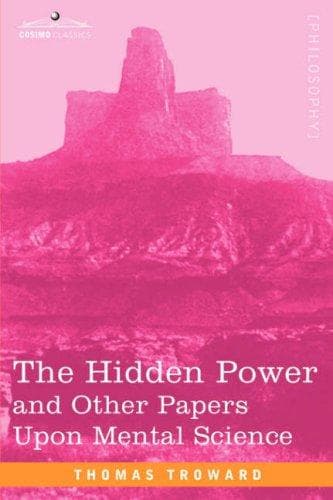
The Hidden Power, and Other Papers upon Mental ScienceTroward, T. (Thomas)
Religion
The Hidden Power, and Other Papers upon Mental Science
Troward, T. (Thomas)
New Thought
We cannot impress upon ourselves too strongly that reality consists of
both an inside and an outside, a generating principle and a generated
condition, and that anything short of the reality of wholeness is
illusion on one side or the other. Nothing could have been further from
Browning's intention than to deter seekers after truth from studying the
principles of Being, for without the knowledge of them truth must always
remain wrapped in mystery; but the lesson he would impress on us is that
of guarding vigilantly the mental equilibrium which alone will enable
us to develop those boundless powers whose infinite unfolding is the
fulness of Life. And we must remember above all that the soul of life is
Love, and that Love shows itself by service, and service proceeds from
sympathy, which is the capacity for seeing things from the point of view
of those whom we would help, while at the same time seeing them also in
their true relations; and therefore, if we would realise that Love which
is the inmost vitalising principle even of the most interior powers, it
must be kept alive by maintaining our hold upon the exterior life as
being equally real with the inward principles of which it is the
manifestation.
1902.
XIV
THE SPIRIT OF OPULENCE
It is quite a mistake to suppose that we must restrict and stint
ourselves in order to develop greater power or usefulness. This is to
form the conception of the Divine Power as so limited that the best use
we can make of it is by a policy of self-starvation, whether material or
mental. Of course, if we believe that some form of self-starvation is
necessary to our producing good work, then so long as we entertain this
belief the fact actually is so _for us_. "Whatsoever is not of
faith"--that is, not in accordance with our honest _belief_--"is sin";
and by acting contrary to what we really believe we bring in a
suggestion of opposition to the Divine Spirit, which must necessarily
paralyse our efforts, and surround us with a murky atmosphere of
distrust and want of joy.
But all this exists in, and is produced by, our _belief_; and when we
come to examine the grounds of this belief we shall find that it rests
upon an entire misapprehension of the nature of our own power. If we
clearly realise that the creative power in ourselves is _unlimited_,
then there is no reason for limiting the extent to which we may enjoy
what we can create by means of it. Where we are drawing from the
_infinite_ we need never be afraid of taking more than our share. That
is not where the danger lies. The danger is in not sufficiently
realising our own richness, and in looking upon the externalised
products of our creative power as being the true riches instead of the
creative power of spirit itself.
Public-domain text, read in full here on John Shaqi.
Reviews
Reviews
No reviews yet
Be the first to share your thoughts on this work.
Elsewhere in the archive
Join the Discussion
Join the discussion
Sign in to leave a comment or review.
Sign InorCreate an account