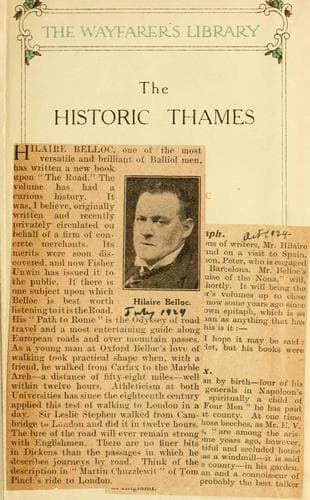
Historic sites -- England -- Thames Valley; Thames Valley (England) -- Description and travel; Thames Valley (England) -- History
It is interesting, in connection with this economic aspect of the
Thames Valley, to note that, alone of the great river valleys of
Europe, it has no railway system parallel to its banks. There is no
series of productive centres which could give rise to such a railway
system. The Great Western Railway follows the river now some distance
upon one side, now some distance upon the other, as far as Oxford; but
it does not depend in any way upon the stream, and where the course of
the stream is irregular it goes on its straight course, throwing out
branch lines to the smaller towns upon the banks: for the railway
depends, so far as this section is concerned, upon the industries of
the Midlands and of the west. Were you to cut off the sources of
carriage which it draws upon from beyond the Valley of the Thames it
could not exist.
The Scheldt, the Rhine, the Rhone, the Garonne, the Seine, the Elbe,
are all different in this from the Thames. The economic power of our
main river valley is chiefly a spending power. It produces little and,
though it exchanges more of human wealth, it is the artificial
machinery of exchange rather than the physical movement of goods that
enriches it.
Now this habit of residence, this settlement of the concentrated power
of demand upon the banks of the Thames, was the work of the monastic
houses. It may be argued that, with the commercial importance of
London, and with its attainment of the position of a capital, the
residence of such economic power would necessarily have spread up the
Thames Valley. It is doubtful whether any such necessity as this
existed. In Roman times the Thames certainly did not lead up thus in
the line of wealth from London, and though it is true that water
carriage greatly increased in importance after the breakdown of Roman
civilisation, yet the medium by which that water carriage was utilised
was the medium of the Benedictine foundations. They it was who
established that continuous line of progressive agricultural
development and who prepared the way for the later yet more continuous
line of the full monastic effort which succeeded the Conquest.
Public-domain text, read in full here on John Shaqi.
Reviews
Reviews
No reviews yet
Be the first to share your thoughts on this work.
Join the Discussion
Join the discussion
Sign in to leave a comment or review.
Sign InorCreate an account