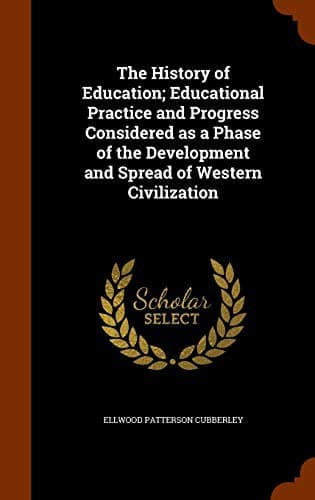
The History of Education: Educational Practice and Progress Considered as a Phase of the Development and Spread of Western CivilizationCubberley, Ellwood Patterson
History
The History of Education: Educational Practice and Progress Considered as a Phase of the Development and Spread of Western Civilization
Cubberley, Ellwood Patterson
Education -- History
EDUCATION BY DOING. It was largely an education by doing, as was that of
the old Greek period, though entirely different in character. Either by
apprenticeship to the soldier, farmer, or statesman, or by participation
in the activities of a citizen, was the training needed imparted. Its
purpose was to produce good fathers, citizens, and soldiers. [11] Its
ideals were found in the real and practical needs of a small State, where
the ability to care for one's self was a necessary virtue. To be healthy
and strong, to reverence the gods and the institutions of the State, to
obey his parents and the laws, to be proud of his family connections and
his ancestors, to be brave and efficient in war, to know how to farm or to
manage a business, were the aims and ends of this early training. It
produced a nation of citizens who willingly subordinated themselves to the
interests of the State, [12] a nation of warriors who brought all Italy
under their rule, a calculating, practical people who believed themselves
destined to become the conquerors and rulers of the world, and a reserved
and proud race, trained to govern and to do business, but not possessed of
lofty ideals or large enthusiasms in life (Rs. 15, 16).
III. THE TRANSITION TO SCHOOL EDUCATION
BEGINNINGS OF SCHOOL EDUCATION. Up to about 300 B.C. education had been
entirely in the home, and in the activities of the fields and the State.
It was a period of personal valor and stern civic virtue, in a rather
primitive type of society, as yet but little in contact with the outside
world, and little need of any other type of training had been felt. By the
end of the third century B.C., the influence of contact with the Greek
cities of southern Italy and Sicily (_Magna Graecia_), and the influence
of the extensive conquests of Alexander the Great in the eastern
Mediterranean (334-323 B.C.), had begun to be felt in Italy. By that time
Greek had become the language of commerce and diplomacy throughout the
Mediterranean, and Greek scholars and tradesmen had begun to frequent
Rome. By 303 B.C. it seems certain that a few private teachers had set up
primary schools at Rome to supplement the home training, and had begun the
introduction of the pedagogue as a fashionable adjunct to attract
attention to their schools. These schools, however, were only a fad at
first, and were patronized only by a few of the wealthy citizens. Up to
about 250 B.C., at least, Roman education remained substantially as it had
been in the preceding centuries. Reading, writing, declamation, chanting,
and the Laws of the Twelve Tables still constituted the subject-matter of
instruction, and the old virtues continued to be emphasized.
Public-domain text, read in full here on John Shaqi.
Reviews
Reviews
No reviews yet
Be the first to share your thoughts on this work.
Join the Discussion
Join the discussion
Sign in to leave a comment or review.
Sign InorCreate an account