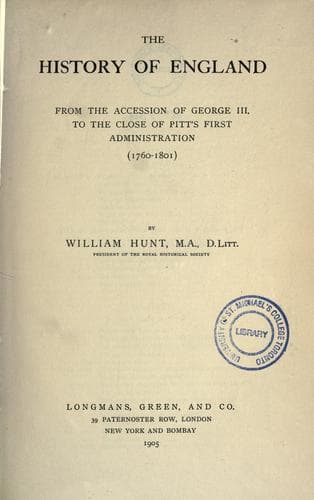
The history of England, from the accession of George III. to the close of Pitt's first administration, 1760-1801Hunt, William
History
The history of England, from the accession of George III. to the close of Pitt's first administration, 1760-1801
Hunt, William
Great Britain -- History -- George III, 1760-1820
That belief was strongly held by the king, and he was delighted by a
letter from Stanley holding out hope of peace.[46] George believed
Choiseul's assurances, and was angry with Pitt for treating them as mere
amusements. At a council on the 21st, Pitt, in an eloquent speech,
pointed out "the almost certainty" of success against the united forces
of the Bourbon monarchies, but, said he, "there is not an hour to lose".
He regretted the concessions which he had been persuaded to make to
France, and "was determined _now_ to abide by his own opinion". The
council adhered to its decision of the 19th. It was plain that Pitt and
Temple would retire, and their colleagues discussed who should succeed
Pitt.[47] George's spirits were dashed by another letter from Stanley
expressing his belief that Spain was contemplating an attack on our ally
the King of Portugal.[48] He could not conceal his ill-temper, and let
it be known that he wished to get rid of Pitt "in all events".[49] He
was soon gratified. Another cabinet meeting was held on October 2 to
decide what orders should be sent to Bristol. Pitt took the same ground
as before, and declared that his opinion had been strengthened by one of
Grimaldi's intercepted letters. Granville, the president of the council,
said that he was convinced that a declaration of war with Spain would
neither be just nor expedient. Newcastle, Devonshire, and Hardwicke
concurred. Bute said that such a war would be dangerous, and in any case
should be put off as long as possible. Anson thought that our ships were
not in a condition for it.[50] Mansfield feared that if England
declared war against Spain the other maritime powers would think that
she was set on destroying them all. Ligonier believed that Spain could
put 70,000 men in the field; she had made "a great figure" in Queen
Anne's reign, and might do so again, and she would be joined by Naples
with an army of 20,000. Temple spoke on Pitt's side, and then appears to
have left the council-room in anger.
Public-domain text, read in full here on John Shaqi.
Reviews
Reviews
No reviews yet
Be the first to share your thoughts on this work.
Join the Discussion
Join the discussion
Sign in to leave a comment or review.
Sign InorCreate an account