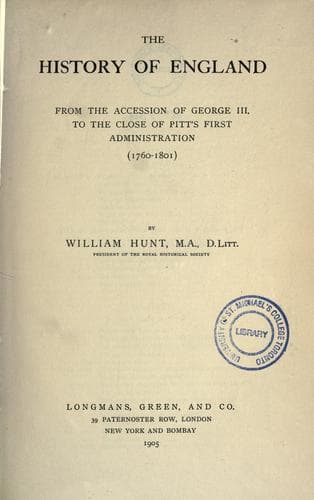
The history of England, from the accession of George III. to the close of Pitt's first administration, 1760-1801Hunt, William
History
The history of England, from the accession of George III. to the close of Pitt's first administration, 1760-1801
Hunt, William
Great Britain -- History -- George III, 1760-1820
The king's petulant wish was fulfilled, but though he and Bute approved
of the decision of the council, Bute thought that Pitt's resignation was
"not favourable in the present minute to the king's affairs". He would
have been well pleased if George could have found in Pitt a minister
subservient to his royal will; he could not endure that he should give
strength to a whig cabinet. Pitt took a line which the king disliked,
yet Bute knew that he could ill be spared so long as the war lasted, and
was annoyed that his intrigues against him had been successful at an
inopportune time. The leaders of the whig oligarchy, and specially
Newcastle, Devonshire, and Bedford, sometimes inspired by Bute, and
sometimes urging him on, had succeeded in driving Pitt out of office.
What was to be their reward? They were to fall back into disunion, and
were consequently to find themselves unable to resist the growth of the
royal power. As for Pitt himself, his resignation dissolved the
unnatural alliance between him and them. His position was tolerable only
so long as he was their master, for in feeling he was not one of them.
As heartily as George himself he hated government by connexion, and like
him desired to break up all parties. He despised the corrupt practices
by which the whigs strengthened themselves, and he had a deep reverence
for the crown. Yet his aims were totally different from those of the
king. He would have broken party ties in order to form a strong
administration; he would have destroyed corruption and looked to the
king and nation for the support of government, and relying on their
support would have crushed the enemies of England. George, on the other
hand, wanted ministers who would carry out his will; he was led to
imitate and, indeed, to surpass the whigs in corrupt practices; he
desired that England should be at peace, and should take no part in
continental politics. Pitt at last stood alone and unconnected. Which
would gain his support, the king or the whigs? The question runs through
the history of the party politics of England during the next eight
years.
Public-domain text, read in full here on John Shaqi.
Reviews
Reviews
No reviews yet
Be the first to share your thoughts on this work.
Join the Discussion
Join the discussion
Sign in to leave a comment or review.
Sign InorCreate an account