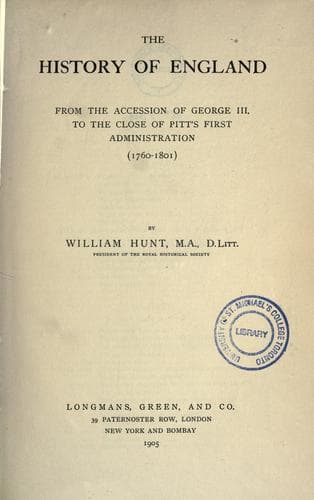
The history of England, from the accession of George III. to the close of Pitt's first administration, 1760-1801Hunt, William
History
The history of England, from the accession of George III. to the close of Pitt's first administration, 1760-1801
Hunt, William
Great Britain -- History -- George III, 1760-1820
About the same time England dealt Spain a heavy blow on the other side
of the world. An expedition under General Draper sailed from Madras in a
fleet commanded by Admiral Cornish, and on September 25 landed at
Manila. The Spaniards, though unprepared, refused to surrender, and the
place was taken by storm. Large government stores were seized by the
victors, but the British commanders allowed the inhabitants to ransom
their property for 4,000,000 dollars. Half this sum was paid in bills on
the Spanish treasury which were rejected at Madrid, and the money was
never paid. With Manila the whole of the Philippines passed to Great
Britain. Though a privateering expedition undertaken with the Portuguese
against Buenos Ayres was beaten off with heavy loss, Spain was unable to
defend the sources of her wealth against the British navy. In May the
capture of the _Hermione_, from Lima, brought over L500,000 to the
captains and crews of the frigate and sloop engaged in the business. A
glorious procession passed through London, carrying the treasure to the
Tower, on August 12, when people were rejoicing at an event scarcely to
be remembered with equal satisfaction, the birth of the future king,
George IV. Two of the ships belonging to the Manila expedition also made
a prize of an Acapulco ship with a cargo worth 3,000,000 dollars.
During the summer Bute treated with France through the Count de Viri.
Bedford urged concessions upon him, and his fear lest the negotiations
should be broken off made him willing to agree to Choiseul's demands. He
would, indeed, have yielded more than he did, if Grenville had not
checked him in the cabinet. In September Bedford was sent to Paris to
settle the preliminaries. Peace was by no means desired by the English
people; they were proud of their victories and were disgusted that Bute
should have the management of affairs. Bedford was hooted in the streets
of London as he set out for Paris. Both Bute and his enemies prepared
for a struggle. Bute, as usual, employed the press to fight for him, and
engaged the services of a number of pamphleteers and newspaper-writers.
His character as a patron of men of letters rests chiefly on the money
which he spent in this way, though it must be set to his credit that he
procured a pension for Samuel Johnson without stipulating for any
return. Among his hired scribes was Smollett, who edited a paper for him
called _The Briton_. The other side, too, was active. In obedience to
Frederick's instructions the Prussian ambassadors took part in exciting
popular discontent with the government; and were justly reproved by
Grenville for their preposterous conduct. Bute was vigorously assailed
in print. The publication of _The Briton_ called forth the ironically
named _North Briton_, of which the first number appeared in June. It was
brought out by John Wilkes, member for Aylesbury, a clever and
dissipated man of fashion, with literary tastes, great courage, an
Public-domain text, read in full here on John Shaqi.
Reviews
Reviews
No reviews yet
Be the first to share your thoughts on this work.
Elsewhere in the archive
Join the Discussion
Join the discussion
Sign in to leave a comment or review.
Sign InorCreate an account