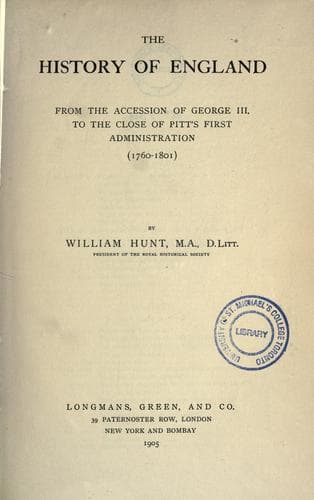
The history of England, from the accession of George III. to the close of Pitt's first administration, 1760-1801Hunt, William
History
The history of England, from the accession of George III. to the close of Pitt's first administration, 1760-1801
Hunt, William
Great Britain -- History -- George III, 1760-1820
Encouraged by Fox's success, George gave the whigs a lesson on the
fruits of opposition. The king, so the court party said, would be king;
the prerogative was to shine out. Devonshire, the "prince of the whigs,"
was forced to resign the chamberlain's staff; the king treated him
uncivilly and with his own hand struck his name from the list of privy
councillors. The whigs were enraged at this high-handed proceeding. The
Marquis of Rockingham resigned the bed-chamber, and George received his
resignation with indifference. Worse was yet to come. Overtures were
made to Pitt by the whigs who gathered round Cumberland, but he would
not connect himself with them. They had defeated his policy, and though
he desired Bute's removal, he would not help to turn him out in order to
put Newcastle back in power.
[Sidenote: _THE TERMS OF PEACE._]
The preliminaries of peace were signed on November 3, and laid before
parliament on the 29th. France agreed to restore Minorca and to evacuate
the territories of Hanover, Hesse, Brunswick, and Prussia. Both parties
were to withdraw their troops from Germany. Dunkirk was to be
dismantled. France resigned Canada, Nova Scotia, and Cape Breton,
together with some territory hitherto claimed as part of Louisiana.
Spain ceded Florida and received back Havana and Manila. Portugal was
restored to its position as before the war. Great Britain restored to
France Belle Ile, Guadeloupe, Mariegalante, Martinique, and St. Lucia,
and retained Grenada, St. Vincent, Dominica, and Tobago. France was
allowed a right of fishery in the gulf of St. Lawrence and on the
Newfoundland coast, and received the islands of St. Pierre and Miquelon
as shelters, covenanting not to fortify them. Spain gave up its claim
to the Newfoundland fishery, agreed that the dispute concerning prizes
should be settled by the courts, and acknowledged the right to cut
logwood on the Bay of Honduras. In Africa England restored Goree to
France and kept Senegal. In India France abandoned her pretensions to
conquests since 1749, and received back the factories which she had at
that date. As a compensation to Spain for the loss of Florida, France
ceded to her Louisiana; a Spanish governor arrived there in 1766, but
though Spain had posts and settlements in the province, she can scarcely
be said to have ever had any effective hold upon it.
Public-domain text, read in full here on John Shaqi.
Reviews
Reviews
No reviews yet
Be the first to share your thoughts on this work.
Elsewhere in the archive
Join the Discussion
Join the discussion
Sign in to leave a comment or review.
Sign InorCreate an account