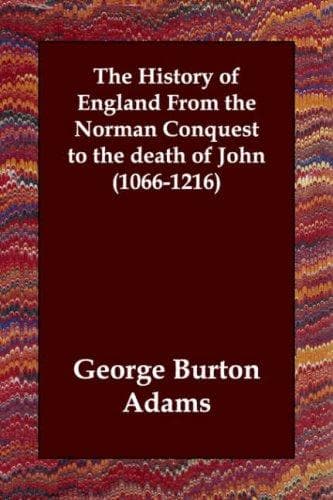
The History of England from the Norman Conquest to the Death of John (1066-1216)Adams, George Burton
History
The History of England from the Norman Conquest to the Death of John (1066-1216)
Adams, George Burton
Great Britain -- History -- Medieval period, 1066-1485
With this new monastic life began a new era of learning. Schools were
everywhere founded or renewed. The universal language of Christendom took
once more its proper place as the literary language of the cloister,
although the use of English lingered for a time here and there. England
caught at last the theological eagerness of the continent in the age when
the stimulus of the new dialectic method was beginning to be felt, and soon
demanded to be heard in the settlement of the problems of the thinking
world. Lanfranc continued to write as Archbishop of Canterbury.[5] Even
something that may be called a literary spirit in an age of general
barrenness was awakened. Poems were produced not unworthy of mention, and
the generation of William's sons was not finished when such histories had
been written as those of Eadmer and William of Malmesbury, superior in
conception and execution to anything produced in England since the days of
Bede. In another way the stimulus of these new influences showed itself in
an age of building, and by degrees the land was covered with those vast
monastic and cathedral churches which still excite our admiration and
reveal to us the fact that the narrow minds of what we were once pleased to
call the dark ages were capable, in one direction at least, of great and
lofty conceptions. Norman ideals of massive strength speak to us as clearly
from the arches of Winchester or the piers of Gloucester as from the firm
hand and stern rule of William or Henry.
In general the Conquest incorporated England closely, as has already been
said, with that organic whole of life and achievement which we call
Christendom. This was not more true of the ecclesiastical side of things
than of the political or constitutional. But the Church of the eleventh
century included within itself relatively many more than the Church of
to-day of those activities which quickly respond to a new stimulus and
reveal a new life by increased production. The constitutional changes
involved in the Conquest, and directly traceable to it through a long
line of descent, though more slowly realized and for long in less
striking forms, were in truth destined to produce results of greater
permanence and a wider influence. The final result of the Norman Conquest
was a constitutional creation, new in the history of the world. Nothing
like this followed in the sphere of the Church. But for a generation or
two the abundant vigour which flowed through the renewed religious life
of Europe, and the radical changes which were necessary to bring England
into full harmony with it, made the ecclesiastical revolution seem the
most impressive and the most violent of the changes which took place in
this age in English public organization and life. If we may trust a later
chronicler, whose record is well supported by independent and earlier
evidence, in the same year in which these legatine councils met, and in
which the reformation of the Church was begun, there was introduced an
Public-domain text, read in full here on John Shaqi.
Reviews
Reviews
No reviews yet
Be the first to share your thoughts on this work.
Elsewhere in the archive
Join the Discussion
Join the discussion
Sign in to leave a comment or review.
Sign InorCreate an account