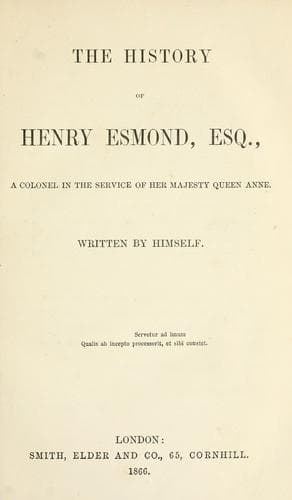
The History of Henry Esmond, Esq., a Colonel in the Service of Her Majesty Queen AnneThackeray, William Makepeace
History
The History of Henry Esmond, Esq., a Colonel in the Service of Her Majesty Queen Anne
Thackeray, William Makepeace
Great Britain -- History -- Anne, 1702-1714 -- Fiction; Historical fiction
“Let's have in Dick the Scholar,” cried Captain Westbury, laughing: and
he called to a trooper out of the window--“Ho, Dick, come in here and
construe.”
A thick-set soldier, with a square good-humored face, came in at the
summons, saluting his officer.
“Tell us what is this, Dick,” says the lawyer.
“My name is Steele, sir,” says the soldier. “I may be Dick for my
friends, but I don't name gentlemen of your cloth amongst them.”
“Well then, Steele.”
“Mr. Steele, sir, if you please. When you address a gentleman of his
Majesty's Horse Guards, be pleased not to be so familiar.”
“I didn't know, sir,” said the lawyer.
“How should you? I take it you are not accustomed to meet with
gentlemen,” says the trooper.
“Hold thy prate, and read that bit of paper,” says Westbury.
“'Tis Latin,” says Dick, glancing at it, and again saluting his officer,
“and from a sermon of Mr. Cudworth's,” and he translated the words
pretty much as Henry Esmond had rendered them.
“What a young scholar you are,” says the Captain to the boy.
“Depend on't, he knows more than he tells,” says the lawyer. “I think we
will pack him off in the coach with old Jezebel.”
“For construing a bit of Latin?” said the Captain, very good-naturedly.
“I would as lief go there as anywhere,” Harry Esmond said, simply, “for
there is nobody to care for me.”
There must have been something touching in the child's voice, or in
this description of his solitude--for the Captain looked at him very
good-naturedly, and the trooper, called Steele, put his hand kindly on
the lad's head, and said some words in the Latin tongue.
“What does he say?” says the lawyer.
“Faith, ask Dick himself,” cried Captain Westbury.
“I said I was not ignorant of misfortune myself, and had learned to
succor the miserable, and that's not YOUR trade, Mr. Sheepskin,” said
the trooper.
“You had better leave Dick the Scholar alone, Mr. Corbet,” the Captain
said. And Harry Esmond, always touched by a kind face and kind word,
felt very grateful to this good-natured champion.
The horses were by this time harnessed to the coach; and the Countess
and Victoire came down and were put into the vehicle. This woman, who
quarrelled with Harry Esmond all day, was melted at parting with him,
and called him “dear angel,” and “poor infant,” and a hundred other
names.
The Viscountess, giving him her lean hand to kiss, bade him always be
faithful to the house of Esmond. “If evil should happen to my lord,”
says she, “his SUCCESSOR, I trust, will be found, and give you
protection. Situated as I am, they will not dare wreak their vengeance
on me NOW.” And she kissed a medal she wore with great fervor, and
Henry Esmond knew not in the least what her meaning was; but hath since
learned that, old as she was, she was for ever expecting, by the good
offices of saints and relics, to have an heir to the title of Esmond.
Public-domain text, read in full here on John Shaqi.
Reviews
Reviews
No reviews yet
Be the first to share your thoughts on this work.
Elsewhere in the archive
Join the Discussion
Join the discussion
Sign in to leave a comment or review.
Sign InorCreate an account