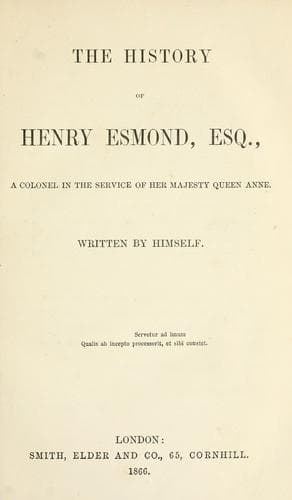
The History of Henry Esmond, Esq., a Colonel in the Service of Her Majesty Queen AnneThackeray, William Makepeace
History
The History of Henry Esmond, Esq., a Colonel in the Service of Her Majesty Queen Anne
Thackeray, William Makepeace
Great Britain -- History -- Anne, 1702-1714 -- Fiction; Historical fiction
“Nay, 'twas the Pagans began it,” cried the lad, and began to instance
a number of saints of the Church, from the proto-martyr downwards--“this
one's fire went out under him: that one's oil cooled in the caldron: at
a third holy head the executioner chopped three times and it would not
come off. Show us martyrs in YOUR church for whom such miracles have
been done.”
“Nay,” says the trooper gravely, “the miracles of the first three
centuries belong to my Church as well as yours, Master Papist,” and then
added, with something of a smile upon his countenance, and a queer look
at Harry--“And yet, my little catechiser, I have sometimes thought about
those miracles, that there was not much good in them, since the victim's
head always finished by coming off at the third or fourth chop, and the
caldron, if it did not boil one day, boiled the next. Howbeit, in our
times, the Church has lost that questionable advantage of respites.
There never was a shower to put out Ridley's fire, nor an angel to turn
the edge of Campion's axe. The rack tore the limbs of Southwell
the Jesuit and Sympson the Protestant alike. For faith, everywhere
multitudes die willingly enough. I have read in Monsieur Rycaut's
'History of the Turks,' of thousands of Mahomet's followers rushing
upon death in battle as upon certain Paradise; and in the great Mogul's
dominions people fling themselves by hundreds under the cars of the
idols annually, and the widows burn themselves on their husbands'
bodies, as 'tis well known. 'Tis not the dying for a faith that's so
hard, Master Harry--every man of every nation has done that--'tis the
living up to it that is difficult, as I know to my cost,” he added with
a sigh. “And ah!” he added, “my poor lad, I am not strong enough to
convince thee by my life--though to die for my religion would give me
the greatest of joys--but I had a dear friend in Magdalen College in
Oxford; I wish Joe Addison were here to convince thee, as he quickly
could--for I think he's a match for the whole College of Jesuits; and
what's more, in his life too. In that very sermon of Dr. Cudworth's
which your priest was quoting from, and which suffered martydom in the
brazier,”--Dick added with a smile, “I had a thought of wearing the
black coat (but was ashamed of my life, you see, and took to this sorry
red one); I have often thought of Joe Addison--Dr. Cudworth says,
'A good conscience is the best looking-glass of heaven'--and there's
serenity in my friend's face which always reflects it--I wish you could
see him, Harry.”
“Did he do you a great deal of good?” asked the lad, simply.
“He might have done,” said the other--“at least he taught me to see and
approve better things. 'Tis my own fault, deteriora sequi.”
“You seem very good,” the boy said.
Public-domain text, read in full here on John Shaqi.
Reviews
Reviews
No reviews yet
Be the first to share your thoughts on this work.
Elsewhere in the archive
Join the Discussion
Join the discussion
Sign in to leave a comment or review.
Sign InorCreate an account