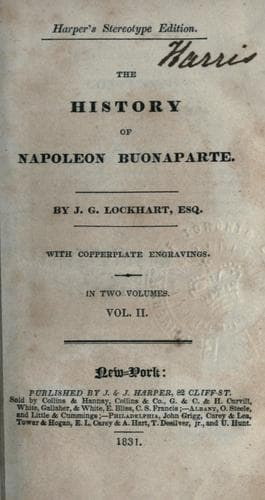
The History of Napoleon BuonaparteLockhart, J. G. (John Gibson)
History
The History of Napoleon Buonaparte
Lockhart, J. G. (John Gibson)
France -- Kings and rulers -- Biography; Napoleon I, Emperor of the French, 1769-1821
Cispadane and the Transpadane--handmaids rather than sisters of the
great French democracy. These events took place during the period of
military inaction which followed the victories of Arcola. The new
Republics hastened to repay Napoleon's favour by raising troops, and
placed at his disposal a force which he considered as sufficient to keep
the Papal army in check during the expected renewal of Alvinzi's
efforts.
Buonaparte at this period practised every art to make himself popular
with the Italians; nor was it of little moment that they in fact
regarded him more as their own countryman than a Frenchman; that their
beautiful language was his mother tongue; that he knew their manners and
their literature, and even in his conquering rapacity displayed his
esteem for their arts. He was wise enough too, on farther familiarity
with the state of the country, to drop that tone of hostility which he
had at first adopted towards the priesthood; and to cultivate the most
influential members of that powerful order by attentions which the
Directory heard of with wonder, and would have heard of, had he been any
other than Napoleon, with scorn and contempt.[12] Wherever he could
have personal intercourse with the priesthood, he seems to have
considerably softened their spleen. Meanwhile the clergy beyond the
Apennines, and the nobility of Romagna, were combining all their efforts
to rouse the population against him; and the Pope, pushed, as we have
seen, to despair by the French Directory, had no reason to complain that
his secular vassals heard such appeals with indifference.
Alvinzi's preparations were in the meantime rapidly advancing. The
enthusiasm of the Austrian gentry was effectually stirred by the
apprehension of seeing the conqueror of Italy under the walls of Vienna,
and volunteer corps were formed everywhere and marched upon the
frontier. The gallant peasantry of the Tyrol had already displayed their
zeal; nor did the previous reverses of Alvinzi prevent them from once
more crowding to his standard. Napoleon proclaimed that every Tyrolese
caught in arms should be shot as a brigand. Alvinzi replied, that for
every murdered peasant he would hang a French prisoner of war:
Buonaparte rejoined, that the first execution of this threat would be
instantly followed by the gibbeting of Alvinzi's own nephew, who was in
his hands. These ferocious threats were laid aside, when time had been
given for reflection; and either general prepared to carry on the war
according to the old rules, which are at least sufficiently severe.
Public-domain text, read in full here on John Shaqi.
Reviews
Reviews
No reviews yet
Be the first to share your thoughts on this work.
Join the Discussion
Join the discussion
Sign in to leave a comment or review.
Sign InorCreate an account