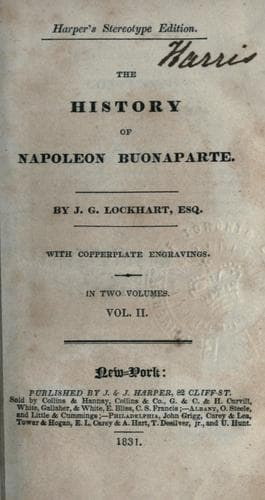
The History of Napoleon BuonaparteLockhart, J. G. (John Gibson)
History
The History of Napoleon Buonaparte
Lockhart, J. G. (John Gibson)
France -- Kings and rulers -- Biography; Napoleon I, Emperor of the French, 1769-1821
In these three days Buonaparte lost 8000 men: the slaughter among his
opponents must have been terrible. Davidowich, in never coming up to
join Alvinzi after his success over Vaubois, and Wurmser, in remaining
quiet at Mantua, when by advancing with his garrison he might have
incommoded the French rear, were guilty of grievous misjudgment or
indecision. Once more the rapid combinations of Napoleon had rendered
all the efforts of the Austrian cabinet abortive. For two months after
the last day of Arcola, he remained the undisturbed master of Lombardy.
All that his enemy could show, in set-off for the slaughter and
discomfiture of Alvinzi's campaign, was that they retained possession of
Bassano and Trent, thus interrupting Buonaparte's access to the Tyrol
and Germany. This advantage was not trivial; but it had been dearly
bought.
A fourth army had been baffled; but the resolution of the Imperial Court
was indomitable, and new levies were diligently forwarded to reinforce
Alvinzi. Once more (January 7, 1797) the Marshal found himself at the
head of 60,000: once more his superiority over Napoleon's muster-roll
was enormous; and once more he descended from the mountains with the
hope of relieving Wurmser and reconquering Lombardy. The fifth act of
the tragedy was yet to be performed.
We may here pause to notice some civil events of importance which
occurred ere Alvinzi made his final descent. The success of the French
naturally gave new vigour to the Italian party, who, chiefly in the
large towns, were hostile to Austria, and desirous to settle their own
government on the republican model. Napoleon had by this time come to be
anything but a Jacobin in his political sentiments: his habits of
command; his experience of the narrow and ignorant management of the
Directory; his personal intercourse with the ministers of sovereign
powers; his sense daily strengthened by events, that whatever good was
done in Italy proceeded from his own skill and the devotion of his
army,--all these circumstances conspired to make him respect himself and
contemn the government, almost in despite of which he had conquered
kingdoms for France. He therefore regarded now with little sympathy the
aspirations after republican organisation which he had himself
originally stimulated among the northern Italians. He knew, however,
that the Directory had, by absurd and extravagant demands, provoked the
Pope to break off the treaty of Bologna, and to raise his army to the
number of 40,000,--that Naples had every disposition to back his
Holiness with 30,000 soldiers, provided any reverse should befall the
French in Lombardy,--and, finally, that Alvinzi was rapidly preparing
for another march, with numbers infinitely superior to what he could
himself extort from the government of Paris;[11] and considering these
circumstances, he felt himself compelled to seek strength by gratifying
his Italian friends. Two Republics accordingly were organised; the
Public-domain text, read in full here on John Shaqi.
Reviews
Reviews
No reviews yet
Be the first to share your thoughts on this work.
Join the Discussion
Join the discussion
Sign in to leave a comment or review.
Sign InorCreate an account