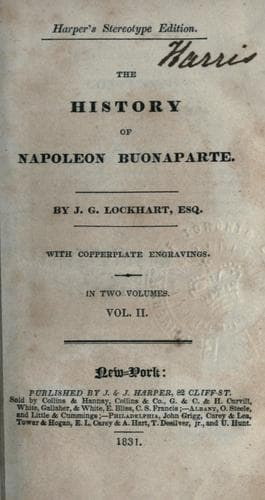
The History of Napoleon BuonaparteLockhart, J. G. (John Gibson)
History
The History of Napoleon Buonaparte
Lockhart, J. G. (John Gibson)
France -- Kings and rulers -- Biography; Napoleon I, Emperor of the French, 1769-1821
Arriving about two in the morning (by another of his almost incredible
forced marches) on the heights of Rivoli, he, the moonlight being clear,
could distinguish five separate encampments, with innumerable
watch-fires, in the valley below. His lieutenant, confounded by the
display of this gigantic force, was in the very act of abandoning the
position. Napoleon instantly checked this movement; and bringing up more
battalions, forced the Croats from an eminence which they had already
seized on the first symptoms of the French retreat. Napoleon's keen eye,
surveying the position of the five encampments below, penetrated the
secret of Alvinzi; namely, that his artillery had not yet arrived,
otherwise he would not have occupied ground so distant from the object
of attack. He concluded that the Austrian did not mean to make his
grand assault very early in the morning, and resolved to force him to
anticipate that movement. For this purpose, he took all possible pains
to conceal his own arrival; and prolonged, by a series of petty
manœuvres, the enemy's belief that he had to do with a mere outpost of
the French. Alvinzi swallowed the deceit; and, instead of advancing on
some great and well-arranged system, suffered his several columns to
endeavour to force the heights by insulated movements, which the real
strength of Napoleon easily enabled him to baffle. It is true that at
one moment the bravery of the Germans had nearly overthrown the French
on a point of pre-eminent importance; but Napoleon himself galloping to
the spot, roused by his voice and action the division of Massena, who,
having marched all night, had lain down to rest in the extreme of
weariness, and seconded by them and their gallant general,[13] swept
everything before him. The French artillery was in position: the
Austrian (according to Napoleon's shrewd guess) had not yet come up, and
this circumstance decided the fortune of the day. The cannonade from the
heights, backed by successive charges of horse and foot, rendered every
attempt to storm the summit abortive; and the main body of the
Imperialists was already in confusion, and, indeed, in flight, before
one of their divisions, which had been sent round to outflank
Buonaparte, and take higher ground in his rear, was able to execute its
errand. When, accordingly, this division (that of Lusignan) at length
achieved its destined object--it did so, not to complete the misery of a
routed, but to swell the prey of a victorious enemy. Instead of cutting
off the retreat of Joubert, Lusignan found himself insulated from
Alvinzi, and forced to lay down his arms to Buonaparte. "Here was a good
plan," said Napoleon, "but these Austrians are not apt to calculate the
value of minutes." Had Lusignan gained the rear of the French an hour
earlier, while the contest was still hot in front of the heights of
Rivoli, he might have made the 14th of January one of the darkest,
instead of one of the brightest days, in the military chronicles of
Napoleon.
Public-domain text, read in full here on John Shaqi.
Reviews
Reviews
No reviews yet
Be the first to share your thoughts on this work.
Join the Discussion
Join the discussion
Sign in to leave a comment or review.
Sign InorCreate an account