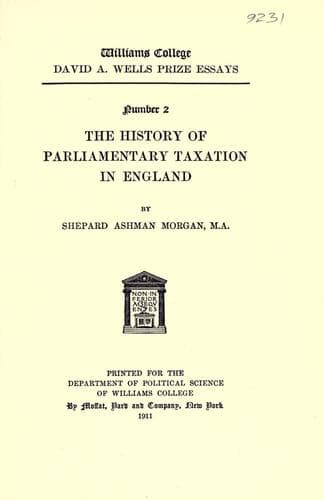
The History of Parliamentary Taxation in EnglandMorgan, Shepard Ashman
History
The History of Parliamentary Taxation in England
Morgan, Shepard Ashman
Taxation -- Great Britain; Taxation -- Great Britain -- History
On that day the barons and higher clergy came together, bringing with
them a heavy burden of grievances. A scheme of reform was drawn up
in the famous Provisions of Oxford. They projected the control of
the government by a number of representative committees.[112] The
only point upon which the Provisions of Oxford touch the question
of taxation is in the section which arranges for the appointment of
a committee of twenty-four “by the whole of Parliament on behalf of
the community” to treat of the aid demanded by the king for the
prosecution of his war. The list of grievances, furthermore, for which
the Provisions were to win redress, did not bring up the matter of the
royal power to levy taxes in any degree whatsoever.[113] The nearest
approach to such an objection came in the complaint against extortions
under the feudal law and in the reference to the manner in which prises
were exacted. In each instance the remonstrance was not against the
principle but against the manner in which the act was accomplished.
[Character of the Provisions]
The Provisions of Oxford furnished no advance in the general progress
toward parliamentary taxation. The only step was a step backward. They
provided for one committee which should have the power of granting
an aid to the king, and delegated to another most of the business of
Parliament. These were movements, not toward the ideal grasped in the
time of Edward I and realized in the Bill of Rights, but of a character
distinctly retrogressive. The government was advantageous to none
save to those who participated in it, and between the participants
there was no mediator in case the distribution of advantages should
be questioned. Theoretically the king’s authority remained, though
it was in restraint; in fact it was given to an irresponsible and
self-interested body of barons subject to the mutual jealousies which
are always the incidents of oligarchic rule.
The provisional government lasted for a year and a half from its
erection in June, 1258, without interruption; thereafter it continued
for four years with a number of breaks until 1263, the year in which
civil war began between Earl Simon and the king.
[King and Earl Simon call knights of the shire to national
assemblies]
Public-domain text, read in full here on John Shaqi.
Reviews
Reviews
No reviews yet
Be the first to share your thoughts on this work.
Join the Discussion
Join the discussion
Sign in to leave a comment or review.
Sign InorCreate an account