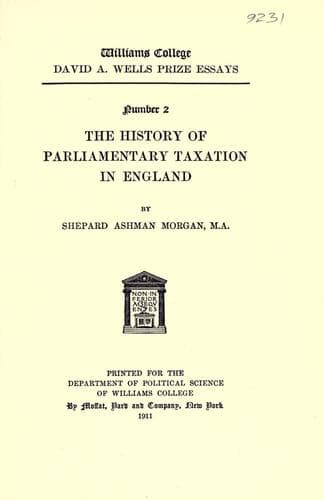
The History of Parliamentary Taxation in EnglandMorgan, Shepard Ashman
History
The History of Parliamentary Taxation in England
Morgan, Shepard Ashman
Taxation -- Great Britain; Taxation -- Great Britain -- History
In the middle of 1261 Henry produced bulls which the Pope Alexander
IV had granted to him shortly before he died absolving him from his
oath to observe the Provisions, and pronouncing excommunication upon
all those who should contravene the absolution.[114] The act of Henry
all but brought forward the impending civil war. Simon de Montfort
and his colleagues, probably in the hope of winning the popular mind
to their cause, acting as chiefs of the provisional government,
addressed summonses to the various sheriffs inviting three knights
from each shire to attend an assembly at St. Albans. Henry, fearing
a general movement against him, sent out counter orders to the
sheriffs, requiring them to send knights not to St. Albans but to
Windsor, _nobiscum super præmissis colloquium habituros_.[115] In
all probability neither of the assemblies met; at least there is no
suggestion of a session of either in the chronicles of the time. They
assume importance, however, as foreshadowing the later Parliaments
of Simon de Montfort, and as indicative of his policy to utilize the
county organization in national matters.
[Civil War, 1263]
Two years later, in June, 1263, Simon de Montfort began war. The
following December the differences between the parties were laid before
Louis IX of France for his decision. He, not unsympathetic with the
plight of his royal brother, made an award in favor of Henry, saving
to the barons and Earl Simon only their rights under the Charter.[116]
But Simon de Montfort was in a position to protest against the
verdict. He vindicated his attitude at the battle of Lewes, 14th
May, 1264, and Henry, his relatives, and his principal adherents
found themselves prisoners in the hands of the barons. A compromise
was effected by the Mise of Lewes, which, after a reconfirmation of
the Provisions, provided for the release of Henry and named a new set
of arbitrators.[117] By the fourth article of the compromise, Henry
was to take the advice of his counsellors in administering justice
and choosing ministers; he was to observe the Charters and to live
moderately.
[Knights of the shire in Parliament, 1264]
But Earl Simon was not satisfied. He garrisoned all the royal castles
with soldiers friendly to his cause, and on the 4th June sent out
writs to the counties in the king’s name summoning to London the
following October, “four lawful and discreet knights,” who were to be
“elected for the purpose by the assent of the county to act for the
whole of that county,” and were to “treat with us of the above-stated
business.”[118] This Parliament when it met proceeded to compose a
new scheme of government, the chief feature of which was a standing
council, indirectly elected by the barons, which should be the moving
force behind all royal acts,--that is, the king was to act only in
accordance with the will of the council.[119]
[Simon de Montfort’s great Parliament, 1265]
Public-domain text, read in full here on John Shaqi.
Reviews
Reviews
No reviews yet
Be the first to share your thoughts on this work.
Join the Discussion
Join the discussion
Sign in to leave a comment or review.
Sign InorCreate an account