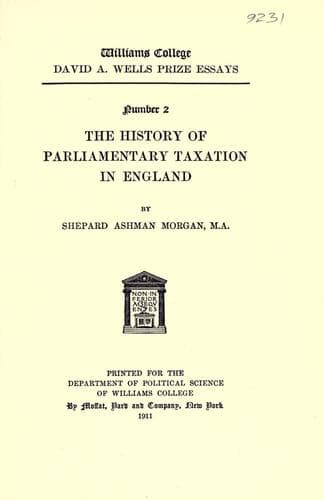
The History of Parliamentary Taxation in EnglandMorgan, Shepard Ashman
History
The History of Parliamentary Taxation in England
Morgan, Shepard Ashman
Taxation -- Great Britain; Taxation -- Great Britain -- History
The events immediately prior to the calling of the Parliament are of
interest. Trouble was on with the Welsh, and a Scotch war began before
the other was over. The French king had transgressed Edward’s Gascon
possessions and his sailors had landed at Dover, putting a convent
and some houses to the torch. Edward’s arms seemed doomed to universal
failure; nowhere were his prospects bright. By no means the least
serious feature of his position was an empty treasury. With the hope of
devising the means of changing his fortune, he summoned to Westminster
for the 1st August a Parliament composed of the barons and prelates of
the realm. The session took place on the 15th August. The bulk of the
debate was upon the proposal for papal mediation between England and
France, and no attempt was made to raise money. But it was doubtlessly
decided to ask for a grant at the meeting of Parliament intended for
the following autumn.[156]
[“What affects all, by all should be approved”]
On the four days from the 30th September to the 3d October, Edward
addressed writs to the clergy, the barons, and the sheriffs, the last
of whom were to send up the representatives of the counties and the
boroughs. In the writs to the clergy, by way of preamble Edward said,
“As a most just law, established by the careful providence of sacred
princes, exhorts and decrees that what affects all, by all should be
approved, so also, very evidently should common danger be met by means
provided in common.”[157] This legal maxim, which had previously held a
place only in the minds of students of the law, was by this act become
a most important element in the governmental practice of England.[158]
The writs provided not only for the attendance of the prelates, but
also for the sending up of representatives of the lower clergy,--the
archdeacons and deans in person, a suitable proctor for the chapters,
and two others for the parochial clergy of each diocese. All were to
have “full and sufficient power ... to consider, ordain, and provide.”
The writs to the barons[159] were similar in tenor to the usual
issuance upon such occasions. To the sheriffs it was “strictly
commanded” that they “cause to be elected without delay” and sent up to
Westminster “two knights from the aforesaid county, two citizens from
each city in the same county, and two burgesses from each borough, of
those who are especially discreet and capable of acting.” All were to
have “full and sufficient power for themselves and for the community of
the aforesaid county ... and the communities of the aforesaid cities
and boroughs separately, then and there for doing what shall then be
ordained according to the common counsel in the premises; so that the
aforesaid business shall not remain unfinished in any way for defect of
this power.”[160]
[The Model Parliament, 27th Nov., 1295]
Public-domain text, read in full here on John Shaqi.
Reviews
Reviews
No reviews yet
Be the first to share your thoughts on this work.
Elsewhere in the archive
Join the Discussion
Join the discussion
Sign in to leave a comment or review.
Sign InorCreate an account