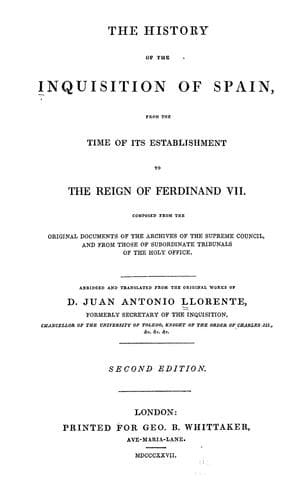
The History of the Inquisition of Spain from the Time of its Establishment to the Reign of Ferdinand VII.Llorente, Juan Antonio
History
The History of the Inquisition of Spain from the Time of its Establishment to the Reign of Ferdinand VII.
Llorente, Juan Antonio
Inquisition -- Spain
Thirdly, that no person should be imprisoned if his crime had not been
sufficiently proved; and that when the arrest had taken place, his
judgment should be immediately pronounced, without waiting for fresh
proofs.
Fourthly, that the Inquisition should acquit deceased persons, if
sufficient proof was not produced, and not delay the trial to wait for
fresh accusations, as it was injurious to the children, whose
establishment was prevented, from the uncertainty of the result of the
trial.
Fifthly, that the entire failure of the funds of the holy office should
not occasion the imposition of a greater number of pecuniary penalties.
Sixthly, that the inquisitors should not change imprisonment, or any
other corporeal punishment, to a pecuniary penalty, but for the
punishment of fasting, alms, pilgrimages, or other similar penances.
Seventhly, that the inquisitors should carefully examine into the
expediency of admitting to reconciliation those who confessed their
crimes after their arrest, since they might be considered as
contumacious, as the Inquisition had been established many years.
Eighthly, that the inquisitors should punish false witnesses publicly.
Ninthly, that two men related in any degree should not be employed in
the holy office, nor a master and his servant, even in case their
functions should be entirely distinct.
Tenthly, that each tribunal should have archives secured by three locks,
the keys of which should be placed in the hands of the two notaries and
the fiscal.
Eleventhly, that the notary should receive the testimony of witnesses
only in the presence of an inquisitor, and that the two priests
commissioned to prove the truth of the deposition should not belong to
the tribunal.
Twelfthly, that the inquisitor should establish the Inquisition in all
towns where it did not already exist.
Thirteenthly, that in all difficult cases the inquisitors should consult
the council.
Fourteenthly, that the women should have a prison separated from that of
the men.
Fifteenthly, that the officers of the tribunal should perform their
functions six hours in a day, and that they should attend the
inquisitors whenever they were required.
Sixteenthly, that after the inquisitors had received the oath of the
witnesses in presence of the fiscal, he should be obliged to retire.
Besides these ordinances, Torquemada established several particular
regulations for each individual belonging to the tribunal: all the
persons employed were obliged to take an oath that they would not reveal
anything they might see or hear: the inquisitor was not allowed to
remain alone with the prisoner; the gaoler could not allow any person to
speak with him, and was obliged to examine if any writings were
concealed in the food which was given him. These were the last
regulations framed by Torquemada, but Diego Deza, his successor,
published a fifth _instruction_ at Seville, in 1500.
Public-domain text, read in full here on John Shaqi.
Reviews
Reviews
No reviews yet
Be the first to share your thoughts on this work.
Join the Discussion
Join the discussion
Sign in to leave a comment or review.
Sign InorCreate an account