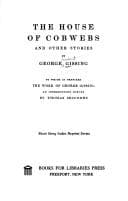
The House of Cobwebs and Other StoriesGissing, George
General
The House of Cobwebs and Other Stories
Gissing, George
Great Britain -- Social life and customs -- 19th century -- Fiction; Short stories
The compulsion of the twin monsters Bread and Cheese forced him to write
novels the scene of which was laid in the one milieu he had thoroughly
observed, that of either utterly hideous or shabby genteel squalor in
London. He gradually obtained a rare mastery in the delineation of his
unlovely _mise en scène_. He gradually created a small public who read
eagerly everything that came from his pen, despite his economy of material
(even of ideas), and despite the repetition to which a natural tendency was
increased by compulsory over-production. In all his best books we have
evidence of the savage and ironical delight with which he depicted to the
shadow of a hair the sordid and vulgar elements by which he had been so
cruelly depressed. The aesthetic observer who wanted material for a picture
of the blank desolation and ugliness of modern city life could find no
better substratum than in the works of George Gissing. Many of his
descriptions of typical London scenes in Lambeth Walk, Clerkenwell, or Judd
Street, for instance, are the work of a detached, remorseless, photographic
artist realising that ugly sordidness of daily life to which the ordinary
observer becomes in the course of time as completely habituated as he does
to the smoke-laden air. To a cognate sentiment of revolt I attribute that
excessive deference to scholarship and refinement which leads him in so
many novels to treat these desirable attributes as if they were ends and
objects of life in themselves. It has also misled him but too often into
depicting a world of suicides, ignoring or overlooking a secret hobby, or
passion, or chimaera which is the one thing that renders existence
endurable to so many of the waifs and strays of life. He takes existence
sadly--too sadly, it may well be; but his drabs and greys provide an
atmosphere that is almost inseparable to some of us from our gaunt London
streets. In Farringdon Road, for example, I look up instinctively to the
expressionless upper windows where Mr. Luckworth Crewe spreads his baits
for intending advertisers. A tram ride through Clerkenwell and its leagues
of dreary, inhospitable brickwork will take you through the heart of a
region where Clem Peckover, Pennyloaf Candy, and Totty Nancarrow are
multiplied rather than varied since they were first depicted by George
Gissing. As for the British Museum, it is peopled to this day by characters
from _New Grub Street_.
There may be a perceptible lack of virility, a fluctuating vagueness of
outline about the characterisation of some of his men. In his treatment of
crowds, in his description of a mob, personified as 'some huge beast
purring to itself in stupid contentment,' he can have few rivals. In
tracing the influence of women over his heroes he evinces no common
subtlety; it is here probably that he is at his best. The _odor di
femmina_, to use a phrase of Don Giovanni's, is a marked characteristic of
his books. Of the kisses--
Public-domain text, read in full here on John Shaqi.
Reviews
Reviews
No reviews yet
Be the first to share your thoughts on this work.
Join the Discussion
Join the discussion
Sign in to leave a comment or review.
Sign InorCreate an account