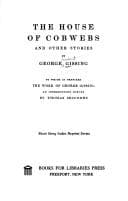
The House of Cobwebs and Other StoriesGissing, George
General
The House of Cobwebs and Other Stories
Gissing, George
Great Britain -- Social life and customs -- 19th century -- Fiction; Short stories
'by hopeless fancy feigned
On lips that are for others'--
there are indeed many to be discovered hidden away between these pages. And
the beautiful verse has a fine parallel in the prose of one of Gissing's
later novels. 'Some girl, of delicate instinct, of purpose sweet and pure,
wasting her unloved life in toil and want and indignity; some man, whose
youth and courage strove against a mean environment, whose eyes grew
haggard in the vain search for a companion promised in his dreams; they
lived, these two, parted perchance only by the wall of neighbour houses,
yet all huge London was between them, and their hands would never touch.'
The dream of fair women which occupies the mood of Piers Otway in the
opening passage of the same novel, was evidently no remotely conceived
fancy. Its realisation, in ideal love, represents the author's _Crown of
Life_. The wise man who said that Beautiful Woman[27] was a heaven to the
eye, a hell to the soul, and a purgatory to the purse of man, could hardly
find a more copious field of illustration than in the fiction of George
Gissing.
[Footnote 27: With unconscious recollection, it may be, of Pope's notable
phrase in regard to Shakespeare, he speaks in his last novel of woman
appearing at times as 'a force of Nature rather than an individual being'
(_Will Warburton_, p. 275).]
Gissing was a sedulous artist; some of his books, it is true, are very
hurried productions, finished in haste for the market with no great amount
either of inspiration or artistic confidence about them. But little
slovenly work will be found bearing his name, for he was a thoroughly
trained writer; a suave and seductive workmanship had become a second
nature to him, and there was always a flavour of scholarly, subacid and
quasi-ironical modernity about his style. There is little doubt that his
quality as a stylist was better adapted to the studies of modern London
life, on its seamier side, which he had observed at first hand, than to
stories of the conventional dramatic structure which he too often felt
himself bound to adopt. In these his failure to grapple with a big
objective, or to rise to some prosperous situation, is often painfully
marked. A master of explanation and description rather than of animated
narrative or sparkling dialogue, he lacked the wit and humour, the
brilliance and energy of a consummate style which might have enabled him to
compete with the great scenic masters in fiction, or with craftsmen such as
Hardy or Stevenson, or with incomparable wits and conversationalists such
as Meredith. It is true, again, that his London-street novels lack certain
artistic elements of beauty (though here and there occur glints of rainy or
sunset townscape in a half-tone, consummately handled and eminently
impressive); and his intense sincerity cannot wholly atone for this loss.
Where, however, a quiet refinement and delicacy of style is needed as in
Public-domain text, read in full here on John Shaqi.
Reviews
Reviews
No reviews yet
Be the first to share your thoughts on this work.
Join the Discussion
Join the discussion
Sign in to leave a comment or review.
Sign InorCreate an account