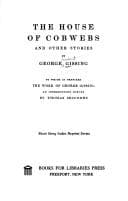
The House of Cobwebs and Other StoriesGissing, George
General
The House of Cobwebs and Other Stories
Gissing, George
Great Britain -- Social life and customs -- 19th century -- Fiction; Short stories
In an ascending road, quiet and tree-shadowed, where the dwellings on
either side were for the most part old and small, though here and there a
brand-new edifice on a larger scale showed that the neighbourhood was
undergoing change such as in our time destroys the picturesque in all
London suburbs, the cheery dreamer chanced to turn his eyes upon a spot of
desolation which aroused his curiosity and set his fancy at work. Before
him stood three deserted houses, a little row once tenanted by middle-class
folk, but now for some time unoccupied and unrepaired. They were of brick,
but the fronts had a stucco facing cut into imitation of ashlar, and
weathered to the sombrest grey. The windows of the ground floor and of that
above, and the fanlights above the doors, were boarded up, a guard against
unlicensed intrusion; the top story had not been thought to stand in need
of this protection, and a few panes were broken. On these dead frontages
could be traced the marks of climbing plants, which once hung their leaves
about each doorway; dry fragments of the old stem still adhered to the
stucco. What had been the narrow strip of fore-garden, railed from the
pavement, was now a little wilderness of coarse grass, docks, nettles, and
degenerate shrubs. The paint on the doors had lost all colour, and much of
it was blistered off; the three knockers had disappeared, leaving
indications of rough removal, as if--which was probably the case--they had
fallen a prey to marauders. Standing full in the brilliant sunshine, this
spectacle of abandonment seemed sadder, yet less ugly, than it would have
looked under a gloomy sky. Goldthorpe began to weave stories about its
musty squalor. He crossed the road to make a nearer inspection; and as he
stood gazing at the dishonoured thresholds, at the stained and cracked
boarding of the blind windows, at the rusty paling and the broken gates,
there sounded from somewhere near a thin, shaky strain of music, the notes
of a concertina played with uncertain hand. The sound seemed to come from
within the houses, yet how could that be? Assuredly no one lived under
these crazy roofs. The musician was playing 'Home, Sweet Home,' and as
Goldthorpe listened it seemed to him that the sound was not stationary.
Indeed, it moved; it became more distant, then again the notes sounded more
distinctly, and now as if the player were in the open air. Perhaps he was
at the back of the houses?
Public-domain text, read in full here on John Shaqi.
Reviews
Reviews
No reviews yet
Be the first to share your thoughts on this work.
Join the Discussion
Join the discussion
Sign in to leave a comment or review.
Sign InorCreate an account