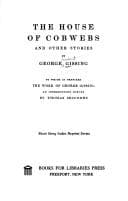
The House of Cobwebs and Other StoriesGissing, George
General
The House of Cobwebs and Other Stories
Gissing, George
Great Britain -- Social life and customs -- 19th century -- Fiction; Short stories
It was Goldthorpe's turn to be embarrassed, for, little as he was prepared
to pay, he did not like to accept a stranger's generosity. They discussed
the matter in detail, with the result that for the arrangement which Mr.
Spicer had proposed there was substituted a weekly rent of two shillings,
the lease extending over a period of three months. Goldthorpe was to live
quite independently, asking nothing in the way of domestic service;
moreover, he was requested to introduce no other person to the house, even
as casual visitor. These conditions Mr. Spicer set forth, in a commercial
hand, on a sheet of notepaper, and the agreement was solemnly signed by
both contracting parties.
On the way home to breakfast Goldthorpe reviewed his position now that he
had taken this decisive step. It was plain that he must furnish his room
with the articles which Mr. Spicer found indispensable, and this outlay, be
as economical as he might, would tell upon the little capital which was to
support him for three months. Indeed, when all had been done, and he found
himself, four days later, dwelling on the top story of the house of
cobwebs, a simple computation informed him that his total expenditure,
after payment of rent, must not exceed fifteenpence a day. What matter? He
was in the highest spirits, full of energy and hope. His landlord had been
kind and helpful in all sorts of ways, helping him to clean the room, to
remove his property from the old lodgings, to make purchases at the lowest
possible rate, to establish himself as comfortably as circumstances
permitted. And when, on the first morning of his tenancy, he was awakened
by a brilliant sun, the young man had a sensation of comfort and
satisfaction quite new in his experience; for he was really at home; the
bed he slept on, the table he ate at and wrote upon, were his own
possessions; he thought with pity of his lodging-house life, and felt a
joyous assurance that here he would do better work than ever before.
In less than a week Mr. Spicer and he were so friendly that they began to
eat together, taking it in turns to prepare the meal. Now and then they
walked in company, and every evening they sat smoking (very cheap tobacco)
in the wild garden. Little by little Mr. Spicer revealed the facts of his
history. He had begun life, in a midland town, as a chemist's errand-boy,
and by steady perseverance, with a little pecuniary help from relatives,
had at length risen to the position of chemist's assistant. For
five-and-twenty years he practised such rigid economy that, having no one
but himself to provide for, he began to foresee a possibility of passing
his old age elsewhere than in the workhouse. Then befell the death of his
uncle, which was to have important consequences for him. Mr. Spicer told
the story of this exciting moment late one evening, when, kept indoors by
rain, the companions sat together upstairs, one on each side of the rusty
and empty fireplace.
Public-domain text, read in full here on John Shaqi.
Reviews
Reviews
No reviews yet
Be the first to share your thoughts on this work.
Elsewhere in the archive
Join the Discussion
Join the discussion
Sign in to leave a comment or review.
Sign InorCreate an account