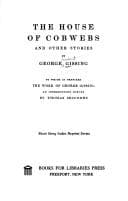
The House of Cobwebs and Other StoriesGissing, George
General
The House of Cobwebs and Other Stories
Gissing, George
Great Britain -- Social life and customs -- 19th century -- Fiction; Short stories
The young author could now do nothing but wait, and, under the
circumstances, waiting meant torture. His money was all but exhausted; if
he could not speedily sell the book, his position would be that of a mere
pauper. Supported thus long by the artist's enthusiasm, he fell into
despondency, saw the dark side of things. To be sure, his mother (a widow
in narrow circumstances) had written pressing him to take a holiday 'at
home,' but he dreaded the thought of going penniless to his mother's house,
and there, perchance, receiving bad news about his book. An ugly feature of
the situation was that he continued to feel anything but well; indeed, he
felt sure that he was getting worse. At night he suffered severely; sleep
had almost forsaken him. Hour after hour he lay listening to mysterious
noises, strange crackings and creakings through the desolate house;
sometimes he imagined the sound of footsteps in the bare rooms below; even
hushed voices, from he knew not where, chilled his blood at midnight. Since
crumbs had begun to lie about, mice were common; they scampered as if in
revelry above the ceiling, and under the floor, and within the walls.
Goldthorpe began to dislike this strange abode. He felt that under any
circumstances it would be impossible for him to dwell here much longer.
When his last coin was spent, and he had no choice but to pawn or sell
something for a few days' subsistence, the manuscript came back upon his
hands. It had been judged--declined.
That morning he felt seriously unwell. After making known the catastrophe
to Mr. Spicer--who was stricken voiceless--he stood silent for a minute or
two, then said with quiet resolve:
'It's all up. I've no money, and I feel as if I were going to have an
illness. I must say good-bye to you, old friend.'
'Mr. Goldthorpe!' exclaimed the other solemnly; 'I entreat you, sir, to do
nothing rash! Take heart, sir! Think of Samuel Johnson, think of
Goldsmith--'
'The extent of my rashness, Mr. Spicer, will be to raise enough money on my
watch to get down into Derbyshire. I must go home. If I don't, you'll have
the pleasant job of taking me to a hospital.'
Mr. Spicer insisted on lending him the small sum he needed. An hour or two
later they were at St. Pancras Station, and before sunset Goldthorpe had
found harbourage under his mother's roof. There he lay ill for more than a
month, and convalescent for as long again. His doctor declared that he must
have been living in some very unhealthy place, but the young man preferred
to explain his illness by overwork. It seemed to him sheer ingratitude to
throw blame on Mr. Spicer's house, where he had been so contented and
worked so well until the hot days of latter August. Mr. Spicer himself
wrote kind and odd little letters, giving an account of the garden, and
earnestly hoping that his literary friend would be back in London to taste
the Jerusalem artichokes. But Christmas came and went, and Goldthorpe was
still at his mother's house.
Public-domain text, read in full here on John Shaqi.
Reviews
Reviews
No reviews yet
Be the first to share your thoughts on this work.
Elsewhere in the archive
Join the Discussion
Join the discussion
Sign in to leave a comment or review.
Sign InorCreate an account