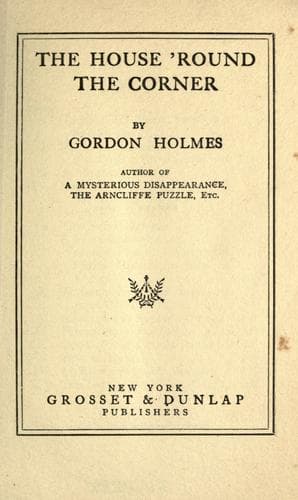
Mystery fiction; Yorkshire (England) -- Social life and customs -- Fiction
"I'm glad you said that, little girl," he said quietly. "I shall not
disappoint you, depend on that. If we have to break every statute
therein made and provided, we'll save your father from the consequences
of his own blundering or wrong-doing. Now, leave everything to me. If
strangers, other than the police, ask you questions, refer them to your
'cousin.' Remember, you know nothing and can tell nothing as to bygone
events, while you can say, if a demand is made for your father's present
address, that I have advised you not to supply it. We must not appear to
be actually defying the authorities. Our role is one of blank ignorance,
combined with a pardonable curiosity to discover what all the fuss is
about. I must not figure as a hindrance to inquiry, but merely as a
distant relative who objects to your being bothered by a matter of which
you, at least, have no knowledge. Now, one thing more--I want to see
your father's handwriting. Will you give me the envelope which contained
his letter?"
"Better still," said Marguerite, drying her eyes with a scrap of lace
which was supposed to be a pocket-handkerchief, "I'll give you the
letter itself. You'll find it a highly incriminating document."
To reach the letter, which she had tucked into a waistbelt, she had to
withdraw the other hand from Armathwaite's shoulder. He had no excuse to
hold her any longer in that protecting way, and his own hands fell.
Suddenly, out of the corner of his eye, he became aware that Percy
Whittaker was gazing at them through the window.
His first impulse was to tell his companion of this covert espionage,
for it was nothing less. The two were talking in the drawing-room, so
Whittaker had purposely walked past the porch in order to look in at
them. Then he decided that the girl had worries in plenty without
embroiling her with one who was admittedly an admirer, so he indulged in
a little bit of acting on his own account.
When she produced the letter, he turned his back on the window,
ostensibly to obtain a better light, and, at the same time, drew
slightly to one side. The handwriting was scholarly but curiously
legible, betraying the habit of a dabbler in strange words who printed
rather than wrote, lest some playful compositor should invent a new and
confounding philology.
The text certainly afforded a weird commentary on the circumstances
which laid at the writer's door responsibility for an audacious crime.
It ran:
"MY DARLING MEG,--Chester has been a bookish city since the days of
Julius Caesar. I have small doubt, if one dug deep in its
foundations, one would come across an original manuscript in J.
C.'s own fist. I would impose a lighter task, however. Rummage one
or two old bookshops, and get me Wentworth Webster's 'Basque
Legends,' published in London in 1877 and 1879. I am hungering for
it. Find it quickly, and come home. I need your sharp eyes.--Yours
ever,
"Dad."
Public-domain text, read in full here on John Shaqi.
Reviews
Reviews
No reviews yet
Be the first to share your thoughts on this work.
Elsewhere in the archive
Join the Discussion
Join the discussion
Sign in to leave a comment or review.
Sign InorCreate an account