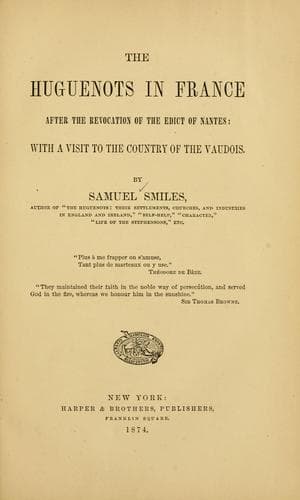
Dauphiné (France) -- Description and travel; Huguenots; Waldenses
On hearing of the martyrdom of Papus, Brousson, in a pastoral letter
which he addressed to his followers, said: "He must have died some
day; and as he could not have prolonged his life beyond the term
appointed, how could his end have been more happy and more glorious?
His constancy, his sweetness of temper, his patience, his humility,
his faith, his hope, and his piety, affected even his judges and the
false pastors who endeavoured to seduce him, as also the soldiers and
all that witnessed his execution. He could not have preached better
than he did by his martyrdom; and I doubt not that his death, will
produce abundance of fruit."
While in Holland, Brousson took the opportunity of having his sermons
and many of his pastoral letters printed at Amsterdam; after which he
proceeded to make a visit to his banished Huguenot friends in England.
He also wished to ascertain from personal inquiry the advisability of
forwarding an increased number of French emigrants--then resident in
Switzerland--for settlement in this country. In London, he met many of
his friends from the South of France--for there were settled there as
ministers, Graverol of Nismes, Satur of Montauban, four ministers from
Montpellier for whom he had pleaded in the courts at Toulouse--the two
Dubourdieus and the two Berthaus--fathers and sons. There were also La
Coux from Castres, De Joux from Lyons, Roussillon from Montredon,
Mestayer from St. Quentin, all settled in London as ministers of
Huguenot churches.
After staying in England for only about a month, Brousson was suddenly
recalled to Holland to assume the office to which he was appointed
without solicitation, of preacher to the Walloon church at the Hague.
Though his office was easy--for he had several colleagues to assist
him in the duties--and the salary was abundant for his purposes, while
he was living in the society of his wife and family--Brousson
nevertheless very soon began to be ill at ease. He still thought of
the abandoned Huguenots "in the Desert"; without teachers, without
pastors, without spiritual help of any kind. When he had undertaken
the work of the ministry, he had vowed that he would devote his time
and talents to the support and help of the afflicted Church; and now
he was living at ease in a foreign country, far removed from those to
whom he considered his services belonged. These thoughts were
constantly recurring and pressing upon his mind; and at length he
ceased to have any rest or satisfaction in his new position.
Accordingly, after only about four months' connection with the Church
at the Hague, Brousson decided to relinquish the charge, and to devote
himself to the service of the oppressed and afflicted members of his
native Church in France. The Dutch Government, however, having been
informed of his perilous and self-sacrificing intention, agreed to
continue his salary as a pastor of the Walloon Church, and to pay it
to his wife, who henceforth abode at the Hague.
Public-domain text, read in full here on John Shaqi.
Reviews
Reviews
No reviews yet
Be the first to share your thoughts on this work.
Elsewhere in the archive
Join the Discussion
Join the discussion
Sign in to leave a comment or review.
Sign InorCreate an account