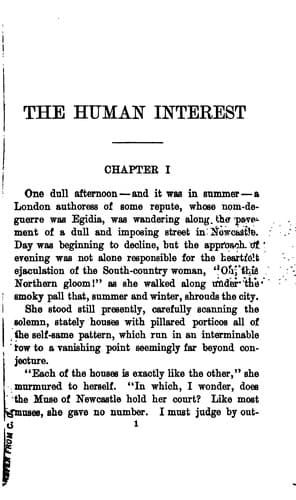
The Human Interest: A Study in IncompatibilitiesHunt, Violet
General
The Human Interest: A Study in Incompatibilities
Hunt, Violet
Man-woman relationships -- Fiction; Women -- England -- Fiction
She was beginning to find him less obscure, for she had learned to seek
for the expression of him in his art: the art by which he chose to
reveal himself to those who had the will and the skill to read. Where
other men spoke or wrote, he painted. She had only to look at the
beautifully stained bits of paper that issued from his hand, to watch
the wonderful combinations of colour--subtle, passionate, striking,
tender--that were evolved by this man of few words, to see that he was
no stranger to the whole gamut of human emotions, full of delightful,
undisciplined moods, and mutabilities, and pleasant perversions of
character. There were strength and force in certain abrupt combinations
that stirred like the sound of a trumpet; there were tenderness and the
fancifulness that women love in certain harmonies that moved almost to
tears. She read sentiment and sweetness in the delicacy of his sunsets,
and character and passion in the gloom of deep cloud-shadows, and sullen
mist-wreaths lurking in clefts and hollows of the hills, and mystery in
the tangled undergrowth whose complication and variety he rendered so
well.
There was one drawing of his that she specially cared for, and whose
progress she surveyed as she might that of a beloved child of his brain
and hers. “Oh, Brignal Banks are wild and fair!” says the lady in
Scott’s ballad, and here they were, caught and immortalized forever on
one piece of Whatman’s paper, three feet by two. There was hardly any
sky in it. The leafy, heavily-berried coverts hung tossing from the
cliff, streaming down to the water’s edge, that lay, in brown pools,
deep and immutable, like a true man’s heart, at its base. In the
immediate foreground was the broken mass of stones that formed the bed
of the wayward river that had so many moods, both of grave and gay.
There the painter sat, on one of these stones, with the water parted and
rippling all round him, in the most precarious of positions, his drawing
propped on his knee, uncomfortably, his feet nearly in the stream. The
burning sun shone straight down on his head, for there was no foothold
for his umbrella in the spot which he had chosen. He never spared
himself, or complained of the terrible constriction of the chest, which
the constrained attitude of stooping necessarily engendered. Perhaps he
did not notice it in the excitement of his work. She sat under his
umbrella, on the bank, and watched him.
Morning after morning she sat there, as it were in a bay of opalescent
colours; the horizon of her landscape bounded by the pink cliffs and
overhanging belts of trees, the foreground quivering with refraction,
and golden with the flowering ragwort. She was drunk, but not blind with
light, and lulled continually by the hum of the bees at their task and
the self-satisfied purl of the stream at her feet, she sat peacefully
noting and enjoying the dreamy transitions of a painter’s day.
Public-domain text, read in full here on John Shaqi.
Reviews
Reviews
No reviews yet
Be the first to share your thoughts on this work.
Join the Discussion
Join the discussion
Sign in to leave a comment or review.
Sign InorCreate an account