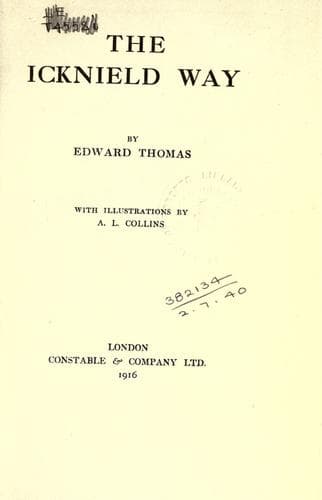
England -- Description and travel; Icknield Way (England); Thomas, Edward, 1878-1917
Winding a little more than before, and still closely attended on its
right by the Great Northern Railway, the road entered Baldock, or
rather it approached that town, and then, refusing to be a main road
any longer, turned off before the Toll Bar Inn to the right. Thus it
dipped into the northern edge of the town close to the railway and the
station, as a long, sordid lane called Bygrave Lane or Deadman’s Lane,
past the gasworks, past the “Stag,” the “Swan,” and the “Black Eagle”
in a row. This was the abode of the “Sand Boys,” who sold sand all over
the country, and bought bones and rabbit skins. It is also the reputed
scene of the death of Gypsy Smith’s wife and his own conversion. Past
the nobly named public-houses the narrow street became a lane, rutted
and half green, and edged on the left with nettles of wondrous height
and density. The railway was closer and closer on the right; on the
left was a new cemetery behind tall railings. At length the railway
passed under the road. I was now again between high, extravagant hedges
of thorn and wild roses. The road was wider, but rough, half green and
half rutted, and in places divided into two by a thicket of blackthorn
standing in the midst. A nightingale was singing among the roses above
some old chalk pits.
After a road from a level crossing had come in on the left, I kept
straight on along the right side of a hedge dividing the railway from a
big field, and past the left edge of a shallow chalk pit. There was no
road here, but several tracks went through the long grass, and mistake
was impossible. On the right two paths went off to some of the new
houses of the Letchworth Garden City, and to a building gigantically
labelled “IDRIS.” This was, I suppose, the temple of this city’s god,
though the name, except as the Welsh equivalent for Arthur, was unknown
to me. They say now that Arthur was a solar hero, and when in doubt
men might do worse than to worship the sun, if they could discover
how. At Letchworth they were endeavouring to do so. The sun was not
benign or even merciful in return for these efforts. He responded by
telling the truth with his most brilliant beams, so that the city
resembled a caravan of bathing machines, except that there was no sea
and the machines could not conveniently be moved. At the end of the
big field I crossed a new road and entered among the elders and thorn
trees of the edge of Norton Common. Here there were several parallel
paths, and on the left behind a hedge was a garden-city street called
“Icknield Way.” This represented the line of the road, but whether this
or the path on the other side of the hedge was more on the old course
I cannot say. Past the houses “Icknield Way” ceased to be a road fit
for perambulators and became a rough track, chiefly used for carrying
building materials. It followed along a hedge and past a sand pit,
in one place a little hollowed out. It was miserable with the rank
grass of newly “developed” districts.
Public-domain text, read in full here on John Shaqi.
Reviews
Reviews
No reviews yet
Be the first to share your thoughts on this work.
Elsewhere in the archive
Join the Discussion
Join the discussion
Sign in to leave a comment or review.
Sign InorCreate an account