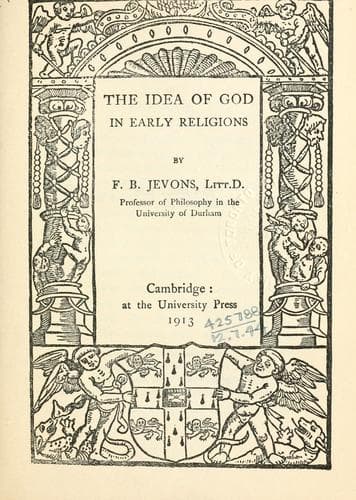
The Idea of God in Early ReligionsJevons, F. B. (Frank Byron)
Religion
The Idea of God in Early Religions
Jevons, F. B. (Frank Byron)
God; Religion
The need and the desire to draw nigh to the god of the community are
felt in the earliest of ages on occasions when calamity befalls the
community. The calamity is interpreted as sent by the god; and the god
is conceived to have been provoked by an offence of which some member
of the community had been guilty. We may say, therefore, that from
the beginning there has been present in the common consciousness a
sense of sin and the desire to make atonement. Psychologically it
seems clear that at the present day, in the case of the individual,
personal religion first manifests itself usually in the consciousness
of sin. And what is true in the psychology of the individual may be
expected within limits to hold true in the psychology of the common
consciousness. But though we may say that, in the beginning, it was by
the occurrence of public calamity that the community became conscious
that sin had been committed, still it is also true to say that the
community felt that it was by some one of its members, rather than by
the community, that the offence had been committed, for which the
community was responsible. It was the responsibility, rather than the
offence, which was prominent in the common consciousness--as indeed
tends to be the case with the individual also. But the fact that the
offence had been committed, not by the community, but by some one
member of the community, doubtless helped to give the community the
confidence without which its attitude towards the offended power would
have been simply one of fear. Had the feeling been one of fear, pure
and unmixed, the movement of the community could not have been towards
the offended being. But religion manifests itself from the beginning
in the action of drawing near to the god. The fact that the offence
was the deed of some one member, and not of the community as a whole,
doubtless helped to give the community the confidence, without which
its attitude towards the offended power would have been simply one of
fear. But it also tended necessarily to make religion an affair of the
community rather than a personal need: sin had indeed been committed,
but not by those who drew near to the god for the purpose of making
the atonement. They were not the offenders. The community admitted its
responsibility, indeed, but it found one of its members guilty.
Public-domain text, read in full here on John Shaqi.
Reviews
Reviews
No reviews yet
Be the first to share your thoughts on this work.
Join the Discussion
Join the discussion
Sign in to leave a comment or review.
Sign InorCreate an account