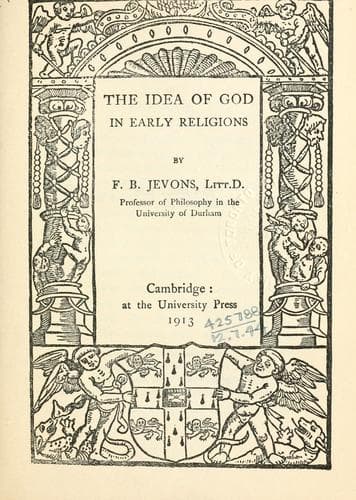
The Idea of God in Early ReligionsJevons, F. B. (Frank Byron)
Religion
The Idea of God in Early Religions
Jevons, F. B. (Frank Byron)
God; Religion
We may, therefore, fairly say that personal religion had at this time
scarcely begun to emerge. And the reason why this was so is quite
clear: it is that in the infancy of the race, as in the infancy of the
individual, personal self-consciousness is as yet undeveloped. And it
is only as personal self-consciousness develops that personal religion
becomes possible. We must not however from this infer that personal
religion is a necessary, or, at any rate, an immediate consequence of
the development of self-consciousness. In ancient Greece one
manifestation--and in the religious domain the first manifestation--of
the individual's consciousness of himself was the growth of
'mysteries.' Individuals voluntarily entered these associations: they
were not born into them as they were into the state and the
state-worship. And they entered them for the sake of individual
purification and in the hope of personal immortality. The desire for
salvation, for individual salvation, is manifest. But it was in rites
and ceremonies that the _mystae_ put their trust, and in the fact that
they were initiated that they found their confidence--so long as they
could keep it. The traditional conviction of the efficacy of ritual
was unshaken: and, so long as men believed in the efficacy of rites,
the question, 'What shall I do to be saved?' admitted of no
permanently satisfactory answer. The only answer that has been found
permanently satisfying to the personal need of religion is one which
goes beyond rites and ceremonies: it is that a man shall love his
neighbour and his God.
But in thus becoming personal, religion involved man's fellow-men as
much as himself. In becoming personal thus, religion became, thereby,
more than ever before, the relation of the community to its God. The
relation however is no longer that the community admits the
transgressions of some one of its members: it prays for the
forgiveness of 'our trespasses'; and though it prays for each of its
members, still it is the community that prays and worships and comes
before its God, as it has done from the beginning of the history of
religion. It is with rites of worship that the community, at any
period in the history of religion, draws nigh to its god; for its
inward purpose cannot but reveal itself in some outward manifestation.
Indeed it seeks to manifest itself as naturally and as necessarily as
thought found expression for itself in the languages it has created;
and, though the re-action of forms of worship upon religion sometimes
results, like the re-action of language upon thought, in misleading
confusion, still, for the most part, language does serve to express
more or less clearly--indeed we may say more and more clearly--that
which we have it in us to utter.
Public-domain text, read in full here on John Shaqi.
Reviews
Reviews
No reviews yet
Be the first to share your thoughts on this work.
Join the Discussion
Join the discussion
Sign in to leave a comment or review.
Sign InorCreate an account