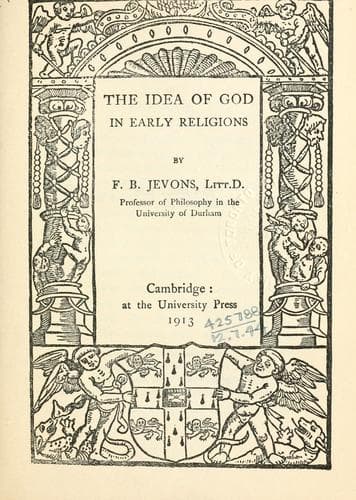
The Idea of God in Early ReligionsJevons, F. B. (Frank Byron)
Religion
The Idea of God in Early Religions
Jevons, F. B. (Frank Byron)
God; Religion
That the two moods are different, and are incompatible with one
another, is clear upon the face of it: to beg for a thing as a mercy
or a gift is quite different from commanding that the thing be done.
The whole attitude of mind assumed in the one case is different from
that assumed in the other. It is possible, indeed, to pass from the
one attitude to the other. But it is impossible to say that the one
attitude is the other. It is correct to say that the one attitude may
follow the other. But it is to be misled by language to say that the
one attitude becomes the other. It is possible for one and the same
man to fluctuate between the two attitudes, to alternate between
them--possible, though inconsistent. The child, or even that larger
child, the man, may beg and scold, almost in the same breath. The
savage, as is well known, will treat his fetish in the same
inconsequential way. That it is inconsequential is a fact; but it is a
fact which, if learned, is but very slowly learned. The process by
which it is learned is part of the evolution of religion; and it is a
process in the course of which the idea of God tends to disengage
itself from the confusion of thought and the confusion of feeling, in
which it is at first enshrouded.
We, indeed, at the present day, may see, or at any rate feel, the
difference between magic and religion, between spell and prayer. And
we may imagine that the difference, because real, has always been seen
or felt, as we see and feel it. But, if we so imagine, we are
mistaken. The difference was not felt so strongly, or seen so
definitely, as to make it impossible to ascribe magic to Moses, or
rain-making to Elijah. In still earlier ages, the difference was still
more blurred. The two things were not discriminated as we now
discriminate them: they were not felt then, as they are felt now to be
inconsistent and incompatible. It was the likeness between the two
that filled the field of mental vision, originally. Whether a man
makes a petition or a command, the fact is that he wants something;
and, with his attention centred on that fact, he may be but little
aware, as the child is little, if at all, aware, that he passes, or is
guilty of unreasonable inconsistency in passing, from the one mood to
the other, and back again. It is in the course of time and as a
consequence of mental growth that he becomes aware of the difference
between the two moods.
Public-domain text, read in full here on John Shaqi.
Reviews
Reviews
No reviews yet
Be the first to share your thoughts on this work.
Join the Discussion
Join the discussion
Sign in to leave a comment or review.
Sign InorCreate an account