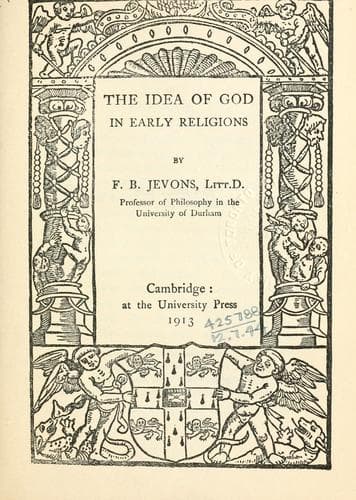
The Idea of God in Early ReligionsJevons, F. B. (Frank Byron)
Religion
The Idea of God in Early Religions
Jevons, F. B. (Frank Byron)
God; Religion
If then there are normative principles of prayer, just as there are of
action, thought and speech; if there are petitions which are not
permissible, and which are not and never can be prayers, though by a
spiritual fallacy, analogous to logical fallacies, they may be thought
to be prayers, what is it that decides the nature of an admissible
petition? It seems to be the conception of the being to whom the
petition is addressed. Thus it is that prayer throws light on the idea
of God. From the prayers offered we can infer the nature of the idea.
The confusion of admissible and inadmissible petitions points to
confused apprehension of the idea of God. It is not merely imperfect
apprehension but confused apprehension. In polytheism the confusion
betrays itself, because it leads to collision with the principles of
morality: of the gods who make war upon one another, each must be
supposed to hold himself in the right; therefore either some gods do
not know what is right, or there is no right to be known even by the
gods. From this confusion the only mode of escape, which is
satisfactory both to religion and to morality, is to recognise that
the unity of morality and the unity of the godhead mutually imply one
another. But so long as a plurality of gods, with a shifting standard
of morality, is believed in, the distinction between admissible and
inadmissible petitions cannot be firmly or correctly drawn.
A tribal god is petitioned to slay the tribe's enemies, because he is
conceived as the god of the tribe and not the god of its enemies. If
the declaration, that 'I am thy servant,' is affirmed with emphasis on
the first personal pronoun, so as to imply that others are no servants
of thine, the implication is that thy servants' enemies are thy
enemies; whereas if there is, for all men, one God only, then all men
are his servants, and not one person, or one tribe, alone. The
conception of God as the god of one tribe alone is an imperfect and
confused apprehension of the idea of God. But it is less so than is
the conception of a god as belonging to one individual owner, as a
fetish does. To a fetish the distinctive, though not the only, prayer
offered, precisely is 'Slay mine enemies'; and therein it is that lies
the difference between a fetish and a god of the community. The
difference is the same in kind as that between a tribal god and the
God of all mankind. The fetish and the tribal god are both inadequate
ideas of God; and the inadequacy implies confusion--the confusion of
conceiving that the god is there only to subserve the desires and to
do the will of the individual worshipper or body of worshippers.
Public-domain text, read in full here on John Shaqi.
Reviews
Reviews
No reviews yet
Be the first to share your thoughts on this work.
Elsewhere in the archive
Join the Discussion
Join the discussion
Sign in to leave a comment or review.
Sign InorCreate an account