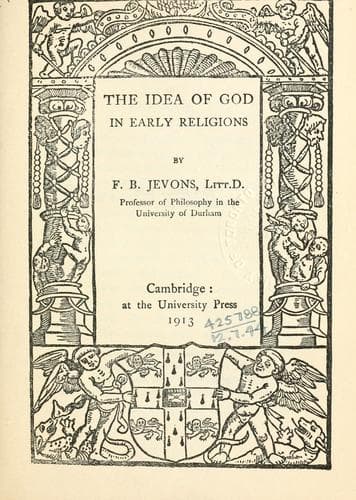
The Idea of God in Early ReligionsJevons, F. B. (Frank Byron)
Religion
The Idea of God in Early Religions
Jevons, F. B. (Frank Byron)
God; Religion
Of this stage we have ample evidence afforded by the cuneiform
inscriptions of Assyria. Spells employed to the hurt of any worshipper
of the gods are spells against which the worshipper may properly
appeal to the gods for protection. A god is essentially the protector
of his worshippers, and he protects each as well as all of them. Each
of them may therefore appeal to him for protection. But though any one
of them may so appeal, it is apparently only in course of time that
individual petitions of this kind come to be put up to the gods. And
the evidence of the cuneiform inscriptions is particularly interesting
and instructive on the way in which this came about.
In the 'Maklu' tablets we find that the writers of the tablets are, or
anticipate that they may be, the victims of spells. The inscriptions
themselves may be regarded, and by some authorities are described, as
counter-charms or counter-spells. They do in fact include, though they
cannot be said to consist of, counter-spells. Their typical feature is
that they include some such phrase as, 'Whoever thou art, O witch, I
bind thy hands behind thee,' or 'May the magic thou hast made recoil
upon thyself.' If the victim is being turned yellow by sickness, the
counter-spell is 'O witch, like the circlet of this seal, may thy face
grow yellow and green.'
The ceremonies with which these counter-spells were performed are
indicated by the words, and they are ceremonies of the same kind as
those with which spells are performed: they are symbolic actions, that
is to say, actions which express by gesture the same meaning and
intention as are expressed by the words. Thus, from the words:
'As the water trickleth away from his body
So may the pestilence in his body trickle away,'
it is obvious that this counter-spell accompanied a ceremonial rite of
the kind indicated by the words. As an image of the person to be
bewitched was used by the workers of magic, so an image of her 'who
hath bewitched me' is used by the worker of the counter-spell, with
the words:
'May her spell be wrecked, and upon her
And upon her image may it recoil.'
Public-domain text, read in full here on John Shaqi.
Reviews
Reviews
No reviews yet
Be the first to share your thoughts on this work.
Elsewhere in the archive
Join the Discussion
Join the discussion
Sign in to leave a comment or review.
Sign InorCreate an account