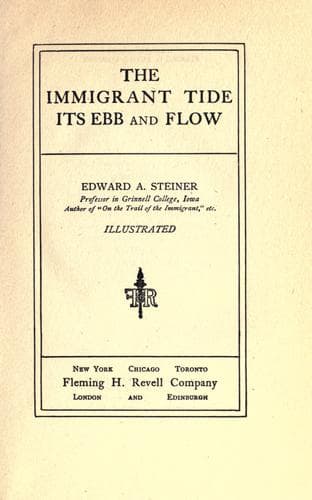
The Immigrant Tide, Its Ebb and FlowSteiner, Edward Alfred
History
The Immigrant Tide, Its Ebb and Flow
Steiner, Edward Alfred
United States -- Emigration and immigration
When last I passed through it, there stood before every one of the
wretched stone huts a giant-like figure, attired in his native costume,
which, according to Montenegrin standards, was worth a fortune, and did
indeed represent its wearer's wealth. Ancient and costly weapons
protruded from his belt, generously wound around his portly body. Thus
armed, he paraded up and down the rocky streets of Nyegusi, or lounged
in the village inn, smoking cigarettes and drinking his _raki_, if he
had the wherewithal.
At the time of which I write, the streets were deserted, save for the
women, who bent beneath their heavy burdens of wood which they bring
down from the ravines in the Lovczin mountain.
Old men sat wearily on the stone walls which surrounded their small
fields, and every one told of a son who had gone "to Amerikee."
One toothless woman could tell her age only approximately, by the number
of sons she had borne; and there were eighteen. Ten of them were in
America; the others had been killed in border warfare.
In this same town I met a mother of twenty-two sons, twenty of whom had
lost their lives in battle. The two survivors were the innkeepers of
Nyegusi. The inn itself was the same as when first I saw it, with its
beaten earth floor, and walls bare, except for the _icon_, a splendid
bit of Byzantine workmanship; but since I drank the excellent coffee
there, ten years ago, more than 5,000 braves have been under its roof,
bound for my own country or returning from it. Now the room is full of
them, all homeward bound, spending money far too freely in drinking and
gambling; two vices which, although taken with them from their
mountains, they bring back in exaggerated form.
I must confess to a sense of disappointment when I saw them beside the
Montenegrin who had remained at home. The sombre dress of our
civilization was a poor exchange for the brilliant, native costume. The
hard labour the men performed in America had robbed them of their erect
and elastic forms, and they looked like the menials of their brothers
who had been keeping watch against the "Schwab," in the shadow of the
Lovczin.
The change was not unlike that which has taken place in the American
Indian who left the war-path to repair the steel path of the railroad.
The men in the inn, nearly thirty of them, belonged to all parts of the
little realm, from Niksic in the North and Grahova on the Herzegovinian
border, to Cetinje and Podgoricza, its centre. They had gone out in
neighbourhood groups, members of one tribe; but, returning, had become
badly mixed. Some in the original group had failed, while others had
succeeded; some decided to remain in America, others were glad to come
home.
Most of those in the inn had been West, and knew only the rigorous side
of our industrial life, and to no European people could the experience
have been so trying; while none could have adjusted itself less easily
to it.
Public-domain text, read in full here on John Shaqi.
Reviews
Reviews
No reviews yet
Be the first to share your thoughts on this work.
Elsewhere in the archive
Join the Discussion
Join the discussion
Sign in to leave a comment or review.
Sign InorCreate an account