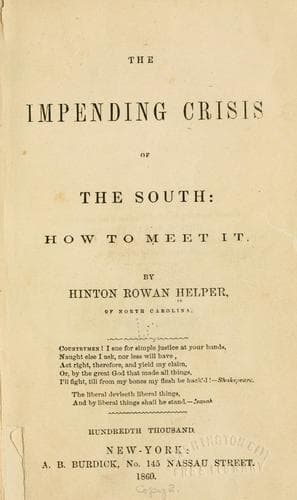
The Impending Crisis of the South: How to Meet ItHelper, Hinton Rowan
History
The Impending Crisis of the South: How to Meet It
Helper, Hinton Rowan
Slavery -- United States
It will be observed that we have omitted the Territories and the District
of Columbia in all the preceding tables. We did this purposely. Our object
was to draw an equitable comparison between the value of free and slave
labor in the thirty-one sovereign States, where the two systems,
comparatively unaffected by the wrangling of politicians, and, as a matter
of course, free from the interference of the general government, have had
the fullest opportunities to exert their influence, to exhibit their
virtues, and to commend themselves to the sober judgments of enlightened
and discriminating minds. Had we counted the Territories on the side of
the North, and the District of Columbia on the side of the South, the
result would have been still greater in behalf of free labor. Though "the
sum of all villanies" has but a mere nominal existence in Delaware and
Maryland, we have invariably counted those States on the side of the
South; and the consequence is, that, in many particulars, the hopeless
fortunes of slavery have been propped up and sustained by an imposing
array of figures which of right ought to be regarded as the property of
freedom. But we like to be generous to an unfortunate foe, and would
utterly disdain the use of any unfair means of attack or defence.
We shall take no undue advantage of slavery. It shall have a fair trial,
and be judged according to its deserts. Already has it been weighed in the
balance, and found wanting; it has been measured in the half-bushel, and
found wanting; it has been apprized in the field, and found wanting.
Whatever redeeming traits or qualities it may possess, if any, shall be
brought to light by subjecting it to other tests.
It was our desire and intention to furnish a correct table of the
gallon-measure products of the several States of the Union; but we have
not been successful in our attempt to procure the necessary statistics.
Enough is known, however, to satisfy us that the value of the milk, wine,
ardent spirits, malt liquors, fluids, oils, and molasses, annually
produced and sold in the free States, is at least fifty millions of
dollars greater than the value of the same articles annually produced and
sold in the slave States. Of sweet milk alone, it is estimated that the
monthly sales in three Northern cities, New York, Philadelphia and Boston,
amount to a larger sum than the marketable value of all the rosin, tar,
pitch, and turpentine, annually produced in the Southern States.
Public-domain text, read in full here on John Shaqi.
Reviews
Reviews
No reviews yet
Be the first to share your thoughts on this work.
Join the Discussion
Join the discussion
Sign in to leave a comment or review.
Sign InorCreate an account