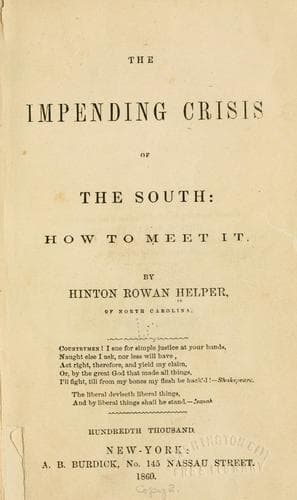
The Impending Crisis of the South: How to Meet ItHelper, Hinton Rowan
History
The Impending Crisis of the South: How to Meet It
Helper, Hinton Rowan
Slavery -- United States
Were we to go beneath the soil and collect all the mineral and lapidarious
wealth of the free States, we should find it so much greater than the
corresponding wealth of the slave States, that no ordinary combination of
figures would suffice to express the difference. To say nothing of the
gold and quicksilver of California, the iron and coal of Pennsylvania, the
copper of Michigan, the lead of Illinois, or the salt of New-York, _the
marble and freestone quarries of New England are, incredible as it may
seem to those unacquainted with the facts, far more important sources of
revenue than all the subterranean deposits in the slave States_. From the
most reliable statistics within our reach, we are led to the inference
that the total value of all the precious metals, rocks, minerals, and
medicinal waters, annually extracted from the bowels of the free States,
is not less than eighty-five million of dollars; the whole value of the
same substances annually brought up from beneath the surface of the slave
States does not exceed twelve millions. In this respect to what is our
poverty ascribable? To the same cause that has impoverished and dishonored
us in all other respects--the thriftless and degrading institution of
slavery.
Nature has been kind to us in all things. The strata and substrata of the
South are profusely enriched with gold and silver, and precious stones,
and from the natural orifices and aqueducts in Virginia and North
Carolina, flow the purest healing waters in the world. But of what avail
is all this latent wealth? Of what avail will it ever be, so long as
slavery is permitted to play the dog in the manger? To these queries there
can be but one reply. Slavery must be suppressed; the South, so great and
so glorious by nature, must be reclaimed from her infamy and degradation;
our cities, fields and forests, must be kept intact from the unsparing
monster; the various and ample resources of our vast domain, subterraneous
as well as superficial, must be developed, and made to contribute to our
pleasures and to the necessities of the world.
A very significant chapter, and one particularly pertinent to many of the
preceding pages, might be written on the Decline of Agriculture in the
Slave States; but as the press of other subjects admonishes us to be
concise upon this point, we shall present only a few of the more striking
instances. In the first place, let us compare the crops of wheat and rye
in Kentucky, in 1850, with the corresponding crops in the same State in
1840--after which, we will apply a similar rule of comparison to two or
three other slaveholding states.
KENTUCKY.
Wheat, bus. Rye, bus.
Crop of 1840 4,803,152 1,321,373
" " 1850 2,142,822 415,073
--------- --------
Decrease 2,660,330 bus. Decrease 906,300 bus.
TENNESSEE.
Public-domain text, read in full here on John Shaqi.
Reviews
Reviews
No reviews yet
Be the first to share your thoughts on this work.
Join the Discussion
Join the discussion
Sign in to leave a comment or review.
Sign InorCreate an account