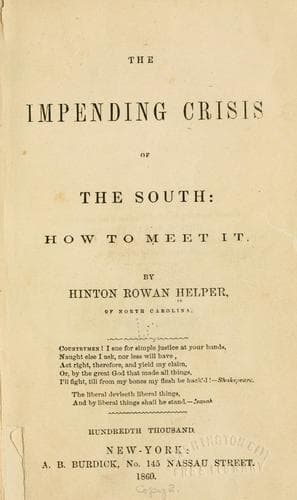
The Impending Crisis of the South: How to Meet ItHelper, Hinton Rowan
History
The Impending Crisis of the South: How to Meet It
Helper, Hinton Rowan
Slavery -- United States
above--the net profits of the North up to 1850--it may be safely assumed
that, in the present year of grace, 1857, _the free States are worth at
least thirty-four hundred million of dollars more than the slave States_!
Let him who dares, gainsay these remarks and calculations; no truthful
tongue will deny them; no honorable pen can controvert them.
One more word now as to the valuation of negroes. Were our nature so
degraded, or our conscience so elastic as to permit us to set a price upon
men, as we would set a price upon cattle and corn, we should be content to
abide by the appraisement of the slaves of the South, and would then enter
into a calculation to ascertain the value of foreigners to the North. Not
long since, it was declared in the South that "one free laborer is equal
to five slaves," and as there are two million five hundred thousand
Europeans in the free States, all of whom are free laborers, we might
bring Southern authority to back us in estimating their value at
_sixty-two hundred million of dollars_--a handsome sum wherewithal to
offset the account of _sixteen hundred million of dollars_, brought
forward as the value of Southern slaves! It is obvious, therefore, that if
we were disposed to follow the barbarian example of the traffickers in
human flesh, we could prove the North vastly richer than the South in bone
and sinew--to say nothing of mind and morals, which shall receive our
attention hereafter. The North has just as good a right to appraise the
Irish immigrant, as the South has to set a price on the African slave. But
as it would be wrong to do either, we shall do neither. It is not our
business to think of man as a merchantable commodity; and we will not,
even by implication, admit "the wild and guilty fantasy," that the
condition of chattelhood may rightfully attach to sentient and immortal
beings.
In this connection, we would direct the special attention of the reader
to the following eloquent passage, exhibiting the philosophy of free and
slave labor, from the facile pen of the editor of the _North American and
United States Gazette_:
Public-domain text, read in full here on John Shaqi.
Reviews
Reviews
No reviews yet
Be the first to share your thoughts on this work.
Elsewhere in the archive
Join the Discussion
Join the discussion
Sign in to leave a comment or review.
Sign InorCreate an account